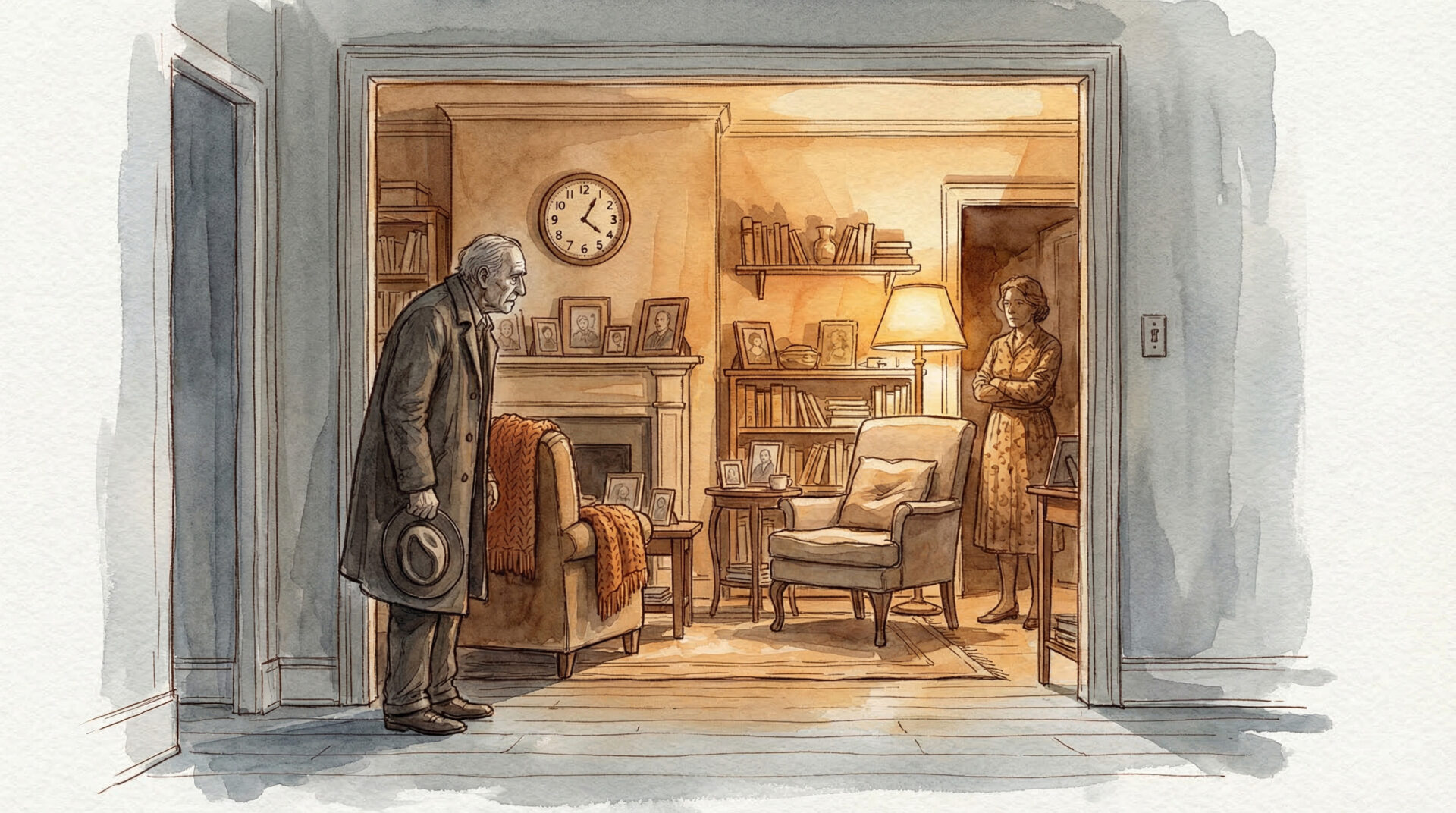
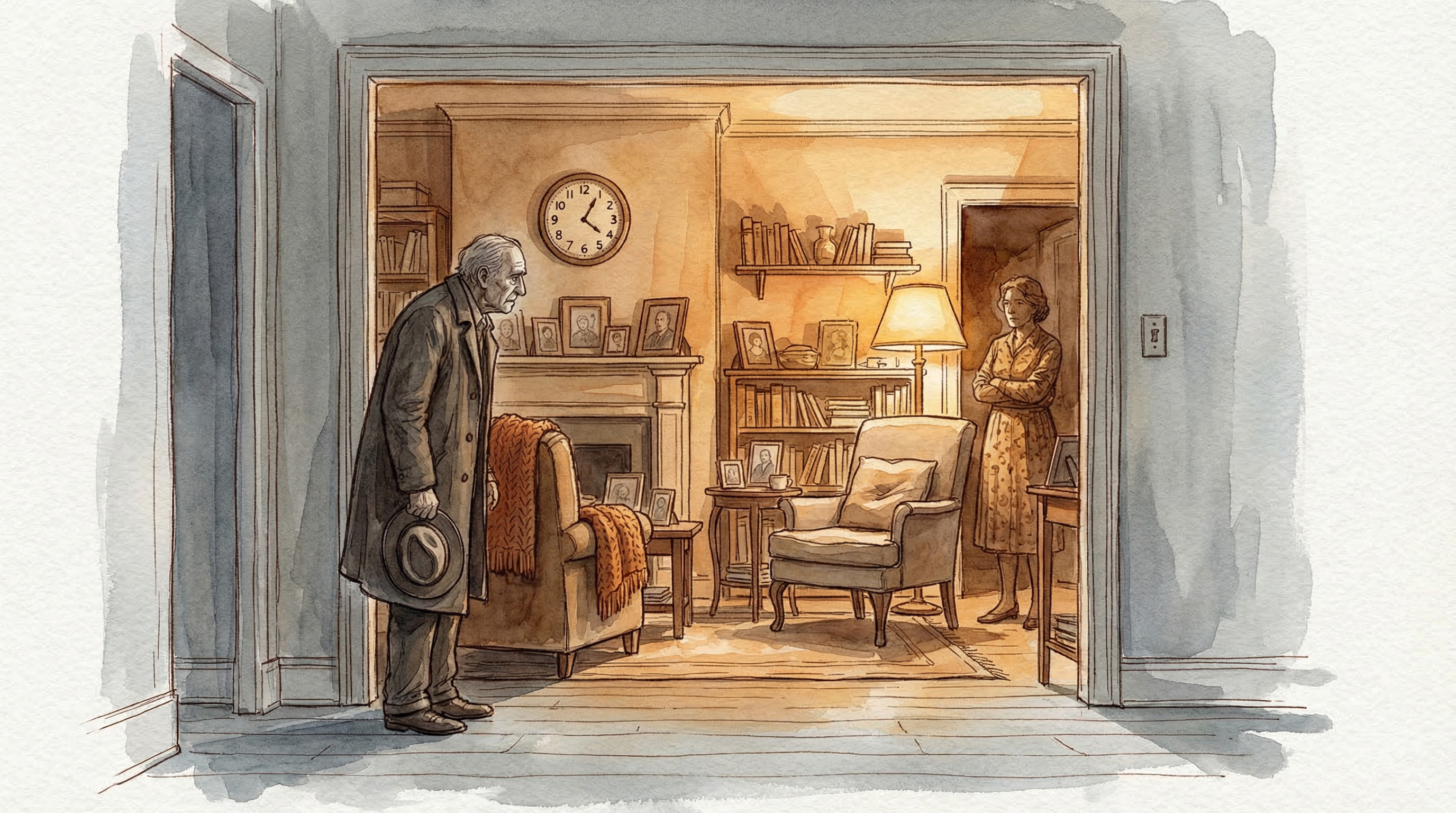
“You’re late,” Miriam said.
“I’m not late. I’m exactly on time.”
“The clock says 4:04.”
“Your clock is fast. It’s always been fast. I told you to fix it in 2041.”
“And I told you I like it fast. Keeps me from being late.”
“So by your own clock, I’m on time.”
Miriam Goldberg pressed her lips together and said nothing, which was its own kind of victory.
Sol stood in the doorway of their apartment—her apartment now, she supposed, though she refused to think of it that way—looking like something the cat dragged in, if they still had the cat, which they didn’t, because the cat had died four years ago and Sol had cried more about that than he’d cried about anything else, which told you something about Sol and his priorities.
“Are you going to stand there all day?”
“I’m waiting for an invitation.”
“Since when do you need an invitation to your own home?”
“It’s not my home anymore. You made that clear.”
“I made nothing clear. You’re the one who left.”
“I didn’t leave. I’m right here.”
“For an hour. Once a week. Like a—like a dentist appointment.”
Sol shuffled inside. He moved slower now, she noticed. The Haven was supposed to maintain muscle tone, supposed to keep the body from atrophying, but there was something about the way he walked that wasn’t quite right. She wouldn’t mention it. She’d save it for later, when she needed ammunition.
“The place looks different,” he said.
“I moved the lamp.”
“Why?”
“Because I wanted to.”
“It looked fine where it was.”
“So I should never change anything? I should live in a museum of how things were when you lived here?”
“I didn’t say that.”
“You implied it.”
“I implied nothing. I made an observation. The lamp is different.”
“The lamp is in a better spot. It gets more light by the window.”
“It’s a lamp. It makes light. It doesn’t need light.”
Miriam turned away so he wouldn’t see her almost smile. Sixty-two years. You’d think she’d be immune by now.
She made tea because that’s what you did. The kettle was new—the old one had finally given up, and she’d replaced it with something modern that heated water in thirty seconds and made a little chiming sound when it was done. She hated the chiming sound. Sol would have hated it more.
“New kettle,” he said, from the living room.
“The old one died.”
“That kettle was forty years old.”
“Things die, Sol.”
A silence. She heard him settle into his chair—the leather one by the window that he’d always claimed had the best reading light, even though he hadn’t read a book in fifteen years.
“Tea’s almost ready,” she said.
“You don’t have to make tea.”
“I know I don’t have to. I want to.”
“Since when do you want to do anything for me?”
“Since when do you notice what I want?”
She brought the tea in, two cups on the tray she’d gotten as a wedding gift in 2004. The tray had outlasted almost everything. The wedding guests, the apartment they’d started in, the jobs, the—
She set the tray down harder than she meant to.
“Careful,” Sol said. “That tray is—”
“I know what the tray is.”
“I was just—”
“I know what you were just.”
He took his cup. Same way he always had — by the rim, not the handle, too impatient to wait for it to cool. She remembered when those hands had been young. When they’d held her differently.
“How’s the Bright?” she asked, making the word sound like a disease.
“It’s fine.”
“Fine. That’s what you left me for. Fine.”
“I didn’t leave you.”
“You’re not here.”
“I’m here right now.”
“For an hour. Like I said. A dentist appointment.”
“You already used that one.”
“So I’m repeating myself. Sue me. I’m old. I repeat myself. At least I’m present to repeat myself.”
Sol sipped his tea. Set it down. Looked out the window at the gray sky, the same gray sky that had hung over New Vesper for as long as anyone could remember.
“The tea is good,” he said.
“It’s the same tea I’ve always made.”
“I know. That’s why it’s good.”
She didn’t know what to do with that, so she did nothing.
“You need to eat more,” she said, fifteen minutes later. “You look thin.”
“I eat plenty.”
“In there? What do you eat in there? Generated food? Simulated nonsense?”
“It tastes fine.”
“Fine again. Everything is fine. The Bright is fine, the food is fine, abandoning your wife is fine—”
“I didn’t abandon you.”
“What would you call it?”
“I would call it—” He stopped. His jaw worked. “I would call it surviving.”
“And what am I doing? What do you think I’m doing out here, Sol? Having a party?”
“I don’t know what you’re doing. You won’t tell me.”
“I won’t tell you? When do you ask? In your one hour a week, when do you ask how I am, what I’m doing, how I’m—” She cut herself off. Too close. She was getting too close to something she didn’t want to touch.
“The doctor says you should be exercising more,” she said instead.
“What doctor?”
“Dr. Vasquez. From the clinic.”
“She’s not my doctor. She’s your doctor.”
“She asks about you. She worries.”
“Then she can come visit.”
“She has other patients. Patients who actually live in the world.”
“I live in the world.”
“You live in a pod, Sol. You live in a machine.”
“The machine keeps me alive.”
“Barely. You call that living?”
“I call it—” He stopped again. Set down his tea. “What do you want from me, Miriam?”
“What do I want?” She laughed, and it came out wrong—too sharp, too brittle. “What do I want. That’s a question. That’s a real question. What do I want. Let me think about that. Let me really consider what I want.”
“So tell me.”
“I want you to pick up your socks. I want you to stop leaving the toilet seat up. I want you to remember to take out the garbage without me having to remind you seventeen times. I want—”
“Miriam.”
“—I want you to stop chewing so loud, I want you to let me pick the movie sometimes, I want you to admit that you’re wrong occasionally, just once, just admit that maybe—”
“Miriam.”
She stopped. Her hands were shaking. When had her hands started shaking?
“I want my husband back,” she said, very quietly.
Sol didn’t say anything. The clock ticked. The new kettle sat on the counter, silent for once, not making its stupid chiming sound.
“I know,” he said finally.
“Then come back.”
“I can’t.”
“You can. You just won’t.”
“It’s the same thing.”
“It’s not the same thing. Can’t means impossible. Won’t means choice.”
“I’m not choosing it over you.”
“Then what are you choosing?”
His mouth opened. Closed. His hands tightened on the arms of the chair.
“I’m choosing not to feel it,” he said. His voice cracked. “You don’t know what it’s like.”
He stopped. Looked at the wall. The wall where the photographs used to hang, before she’d taken them down, before she’d put them in a drawer because she couldn’t stand to walk past them anymore.
“I know what it’s like,” she said.
“No. You don’t.”
“You think you’re the only one? You think it doesn’t—” Now her voice was breaking too. “You think I don’t wake up every morning and have to remember all over again? You think I don’t reach for the phone to call him and then—”
“Don’t.”
“—and then remember that there’s no one to call? That he’s—”
“Don’t.”
The word was sharp enough to cut. Sol was crying now, silently, the way he’d cried about the cat, the way he’d cried at the funeral, the way he’d cried every day for six months before he finally gave up and went into the pod.
David. Their son. He’d come out of the Bright after two years, seemed like he was doing better. And then one morning Miriam found him in the garage.
“The Bright doesn’t make it go away,” Sol said. “But it makes it… smaller. Far away. Like it happened to someone else.”
“It happened to all of us.”
“I know.”
“It happened to me too.”
“I know.”
“And I’m still here. I’m still—” She gestured at the apartment, at herself, at everything she was holding together through sheer stubbornness. “I’m still doing this. Without you. Because you left.”
“I know.”
“Stop saying that.”
“What do you want me to say?”
“I want you to say you’re coming home for dinner.”
Sol looked at her. She looked back.
Neither of them spoke for a while. Sol looked at the window. Miriam looked at the tea, which was getting cold, which she would have to reheat, which meant listening to the chime again.
The radiator clanked. Twice, then a long rattle, then silence.
“That’s new,” Sol said.
“It’s been doing that for a year.”
“A year? That’s the bleed valve. You need to open it, let the air out.”
“I know what a bleed valve is.”
“Have you bled it?”
“I called the building super. He said he’d come. He didn’t come.”
“Kaplan never comes. I told you that for thirty years. You bleed it yourself. There’s a key in the kitchen drawer, the one with the rubber bands and the batteries.”
“That drawer is a disaster.”
“The key is in the back left corner. Small brass thing. You put it on the valve at the top of the unit and turn it counterclockwise until you hear hissing, then close it when water starts to drip.”
“I know how to bleed a radiator, Sol.”
“Then why haven’t you bled it?”
She didn’t answer. He looked at her. She looked at the radiator.
“It’s heavy,” she said. “The key is stiff. I couldn’t turn it.”
Something shifted in his face. Not pity — she would have hit him for pity. Something worse. The recognition of all the small things that had gone wrong without him, the accumulation of stuck keys and unreturned calls and a woman alone in an apartment with a radiator she couldn’t fix.
He stood up. Went to the kitchen. She heard the drawer open, heard him rummaging, heard him mutter something about the state of the drawer, which was exactly what he would have said if he’d never left. He came back with the key.
He knelt by the radiator, slowly, his knees protesting. She watched his hands — still sure, still knowing where to go, even after three years in a pod. He fit the key to the valve. Turned it. The hiss of trapped air escaping, then a trickle of dark water into the cup she’d been putting underneath.
“You need a bigger cup,” he said. “This one’s too small.”
“It works fine.”
“It’s a teacup, Miriam. You’re using a teacup to catch radiator water.”
“I didn’t have anything else.”
He closed the valve. Stood up, holding the wall for balance. The radiator ticked once, then settled into the quiet, even heat it was supposed to produce.
“There,” he said. He put the key on the coffee table, next to the tea tray. Sat back down.
They listened to the radiator being quiet. It was a good silence. A warm one.
The clock ticked. Five more minutes until his hour was up, until the Haven van was back to pick him up, until she was alone again with the moved lamp and the new kettle and the photographs in the drawer.
“The pod is uncomfortable,” Sol said.
“Good.”
“The food is terrible.”
“I know. You said fine, but I knew you meant terrible. You always say fine when you mean terrible.”
“And the people—” He shook his head. “They don’t argue. Everyone just agrees with each other. It’s maddening.”
“Sounds like hell.”
“It is hell. It’s a very pleasant, comfortable, well-lit hell.”
Miriam felt something loosen in her chest. Something she’d been holding tight for three years.
“What are you saying, Sol?”
“I’m saying—” He looked at her. Really looked, the way he used to. “I’m saying the tea is better here.”
She stood up. Her knees ached. Everything ached.
Three years of holding on alone, and now this, now him, now the possibility of—
“If you think I’m taking you back just because the pod food is bad—”
“I don’t think that.”
“Because I’ve been doing fine without you. Just fine. I’ve reorganized the whole apartment. I’ve joined a book club. I’ve made friends with the woman downstairs, the one you always said talked too much—”
“Mrs. Patterson talks too much. That’s not an opinion. That’s a fact.”
“She’s a lovely woman.”
“She’s a lovely woman who talks too much.”
Miriam was crying now, which was ridiculous, which she hated, which she would never forgive him for. “You can’t just come back. You can’t just decide after three years that you’re done hiding and expect me to—”
“I don’t expect anything.”
“Good. Because I’ve moved on. I’ve adapted. I’ve—”
“You moved the lamp six inches to the left and bought a kettle with a chime.”
“I’ve made changes.”
“You hate the chime. You wince every time it goes off.”
“How do you know I wince?”
“Because I know you.” He stood up too, slower than her, his body remembering that it wasn’t supposed to move this way anymore.
They stood there, the coffee table between them, the tray with the wedding gift cups, the apartment that was too big for one person and had always been too small for two.
“You’ll be back in the pod within a week,” she said.
“Probably.”
“You’ll get bored, or sad, or tired of my cooking—”
“Your cooking is the only thing I miss.”
“—or tired of me. You’ll get tired of me.”
“I’ve been tired of you for sixty years. I’m still here.”
“You’re not here. You’re in a machine.”
“I’m here now.”
The clock chimed. His hour was up.
“Go,” she said. “They’re calling you.”
“Let them call.”
“Sol—”
“I said let them call.” He moved around the coffee table, slowly, an old man navigating furniture he used to walk past without thinking. He stopped in front of her. Close enough to touch, which she hadn’t let him do in three years, which she’d told herself she didn’t want anymore.
“I’m coming home,” he said.
“When?”
“Tonight. I’ll go sign the papers and be back for dinner.”
“That’s not how it works. There’s a process—”
“So I’ll process.”
“You’ll change your mind.”
“I won’t.”
“You will. You always do. You always—” She was crying harder now, which she really hated. “You always leave.”
“Not this time.”
“How do you know?”
“Because the tea is better here.” He reached out, his hand shaking almost as much as hers. “And because you moved the lamp, and I need to move it back.”
“Don’t you dare touch my lamp.”
He kissed her. It was awkward, off-center, the kind of kiss that happened when you were both old and crying and had forgotten how to do this. She kissed him back anyway.
“You’re a terrible husband,” she said against his mouth.
“I know.”
“Sixty-two years and you still don’t know how to kiss properly.”
“I know.”
“Don’t you dare die before me. I’m not doing this again.”
“I’ll do my best.”
She pulled back. Wiped her face.
“You’ll need to see Dr. Vasquez,” she said. “Your muscle tone is terrible.”
“My muscle tone is fine.”
“It’s not fine. You walk like you’re ninety.”
“I am ninety.”
“You’re eighty-eight. Don’t add years just to win arguments.”
“I’m not adding years. I’m rounding up.”
“You don’t round up. You’re not that close to ninety.”
“I’m close enough.”
She handed him his coat. The one he’d left hanging by the door three years ago, the one she hadn’t been able to throw away, the one she’d sometimes touched late at night when the apartment felt too empty.
“I’m not setting that clock back,” she said. “I don’t care what you say.”
“It’s three minutes fast.”
“So you’ll learn to be early.”
He put on the coat. It was too big now; he’d lost weight in the pod, despite what they promised. She’d fatten him up. She’d make his favorites, the ones he’d complained about for years while eating three helpings.
“Miriam.”
“What.”
“Thank you.”
“For what? I didn’t do anything. I just sat here. Waiting. Like an idiot.”
“I know.” He opened the door. Looked back at her. “That’s what I’m thanking you for.”
He left before she could respond, which was typical, which was just like him, which she would yell at him about later.
The door closed.
She stood in the empty apartment, looking at the lamp, the kettle, the clock that was three minutes fast.
Then she went to the kitchen and started planning dinner.