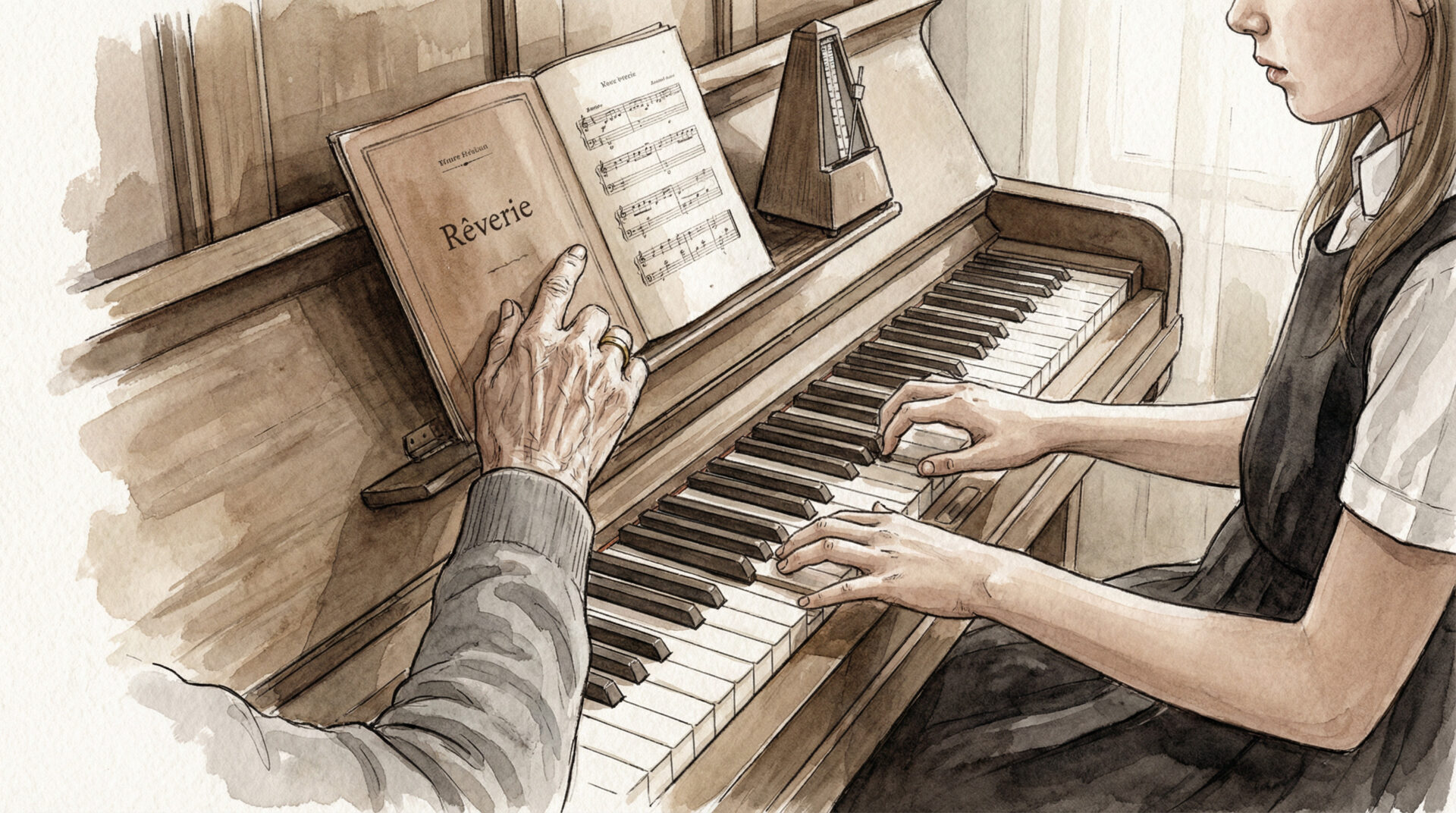
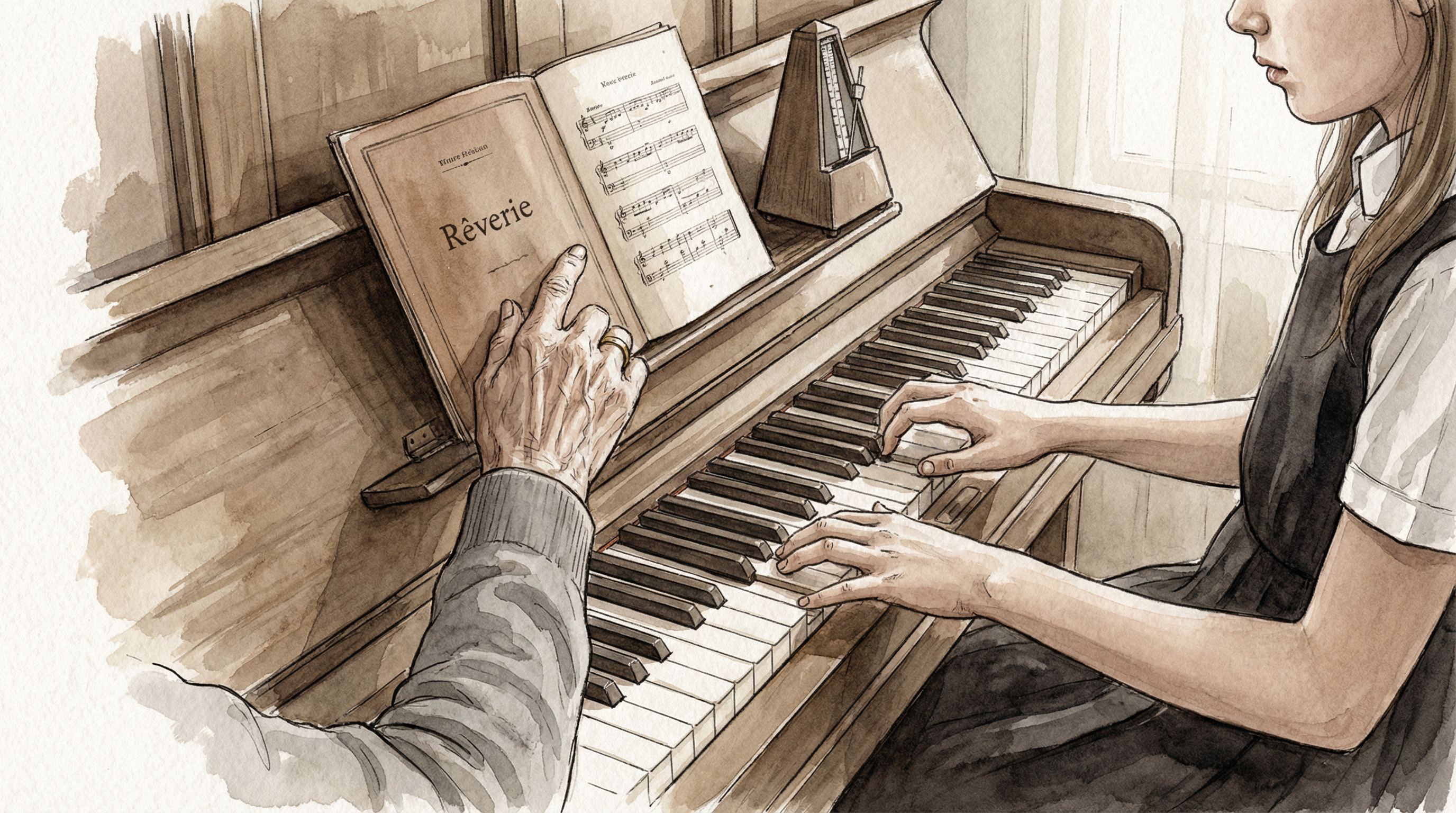
The metronome was off by two beats per minute.
Agnes had suspected it for a week. She’d tested it against the clock in the kitchen — the one Werner had mounted above the stove in 2031, forty minutes with a level and a pencil because Werner did not hang things crooked, and which had kept perfect time for thirty-five years because it was German and mechanical and did not know how to stop.
The metronome was fast. Not enough that a student would notice. Enough that Agnes noticed, and noticing was her job.
She adjusted the weight. Set it going. Counted against the second hand. One hundred and twenty beats per minute, now correct.
The front room was ready. The piano lid was up, the keys wiped with a soft cloth, the music stand set at the angle that caught the afternoon light without glare. On the small table beside the bench, two cups. Saucers beneath them. The pot would go on when the lesson ended, not before — tea was the reward, not the accompaniment.
Outside, Linden Close was quiet. It was always quiet. Eight houses arranged in a half-moon around a paved turning circle. Three years ago, five of the eight had been occupied. Now Agnes was at number two, Mr. Petersen was at number six, and Yelena and the girl were at number five.
The other five houses had their curtains drawn or their curtains gone. Lawns grew to the windows. A bicycle leaned against a fence at number four, its tires flat, its chain rusted to the color of the fence. At number seven, the Karimis had left a swing set in the back garden. Agnes could see it from her kitchen window. She’d stopped looking.
It was three fifty-eight.
She straightened the music on the stand. Debussy, “Rêverie,” simplified for small hands. The girl had been working on the opening for two weeks. The left hand was correct. The right hand rushed.
At four o’clock exactly, the doorbell rang.
Agnes smoothed her skirt. Checked that the second button of her cardigan was fastened, because it came loose when she sat and she did not like to fidget. She went to the door.
Nadia stood on the step in her school uniform and a coat that was too large for her. The backpack hung past her waist. Her dark hair was in a braid that had been neat that morning and was now coming undone on the left side.
“Good afternoon, Frau Müller.”
“Good afternoon, Nadia. Come in.”
The girl came in. She took off her shoes — she always took off her shoes without being asked, which Agnes had noticed and never praised, because it did not need praise; it needed doing. She set the backpack by the wall and took out her piano books, which were covered in brown paper. Agnes had taught her to cover them. The covers were creased now, and on the front of the Debussy book, a small pencil drawing of a cat.
“Your mother?”
“She said she’d come at five.”
Agnes looked past the girl to the close. Yelena’s car was in the drive at number five. It had been in the drive for four days. She knew this because she could see it from the kitchen window.
“Very well. Let’s begin.”
—
They sat at the bench. Agnes on the left, Nadia on the right. The girl’s feet didn’t reach the pedals, so Agnes had placed a wooden box — Werner’s — on the floor for her right foot. Someday the girl would reach. Not yet.
“Scales first. C major. Both hands. Correct tempo.”
Nadia played. Her posture was good — back straight, wrists level, the way Agnes had taught her. The scales were clean. The left hand, always her stronger hand, carried the weight. The right followed a half-beat behind, a hesitation so slight that most teachers wouldn’t catch it.
“The right hand is following,” Agnes said. “It should arrive at the same time as the left. Not after.”
“I know.”
“Knowing is not doing. Again.”
The girl played again. Better. The synchronization tighter, the right hand keeping pace. Agnes listened the way she had listened for fifty years — not to the notes, which were correct, but to the spaces between the notes, where the truth of a player’s technique lived.
“Good. D major.”
They worked through the scales. Agnes corrected the thumb crossing in B-flat major, which the girl had been doing wrong for two months and had finally, today, done right.
“Better,” Agnes said.
The girl’s shoulders dropped a fraction. Relief. Agnes saw it and did not soften. Better was better. It was not yet good.
“Now. The Debussy. From the beginning.”
Nadia opened the book. The opening bars of “Rêverie” — the left hand’s gentle, rolling accompaniment, the right hand’s melody floating above it. The girl played and the music was careful. Correct. Every note in its place, the dynamics marked as written.
Agnes listened. It was accurate and it was empty.
“Stop.”
The girl stopped.
“You’re reading it,” Agnes said. “You’re not hearing it.”
Nadia looked at her.
“What do you mean?”
“You’re playing what’s written on the page. That’s necessary. But Debussy didn’t write this piece so someone would play the correct notes in the correct order. He wrote it because he heard something and wanted someone else to hear it too.” Agnes placed her hands on the keys. “Listen.”
She played the opening. Her left hand found the rolling pattern and her right hand took the melody and for a moment the room was different — the afternoon light, the curtains, the empty street, all of it gathered into the sound.
The tremor was in her left hand. It had been there for eight months. She controlled it through the wrist, absorbing the shake before it reached the fingers. It cost her something. She didn’t show it.
She stopped. Took her hands off the keys.
“Again,” she said.
The girl played. This time, something shifted. The right hand found a different quality — not louder, not softer, but more present. As if the melody had stopped being marks on paper and become a voice.
Agnes listened and said nothing. The girl played to the end of the first page.
“Continue at home,” Agnes said. “Practice the second page. Left hand alone, twenty times. Then both hands together. Your mother will sign the sheet.”
She took the practice sheet from the folder. At the top: *Nadia Volkov. Week 147.* Below: the assignment, neatly printed, with a line for the parent’s signature.
The girl took the sheet, folded it, and put it in the book.
“Tea,” Agnes said, and went to the kitchen.
—
She filled the kettle. Set out the pot. Two cups on the counter — the blue ones with the thin gold rim, which had been her mother’s, which she used for tea because her mother had used them for tea and that was what they were for.
From the front room, the sound of Nadia playing. Not the Debussy — something else, something the girl played when she thought Agnes wasn’t listening. A simple melody, repeated. The left hand holding a pattern while the right hand tried variations, reaching for something the girl couldn’t quite catch.
Agnes stood at the counter and listened. The kettle heated. The girl played. Outside, the close was empty.
The door at number five had not opened.
Agnes poured the tea. Carried the tray to the front room. Set it on the small table. Nadia stopped playing and put her hands in her lap.
“What was that?” Agnes said.
“Nothing. Something I made up.”
“It has a nice shape.”
The girl looked at her. Agnes poured the tea. Two cups. She set one in front of Nadia and took the other.
“Frau Müller?”
“Yes.”
“Do you think Debussy practiced a lot?”
“I think he practiced until he didn’t have to think about practicing.”
The girl considered this. She held her cup with both hands, the way children do, absorbing the warmth.
“My mother says practice doesn’t matter if you have talent.”
“Your mother is wrong.”
The words were out before Agnes could soften them. She pressed her lips together. But the girl didn’t flinch.
They drank their tea. At five fifteen, Nadia put on her coat and her backpack and stood at the door.
“Your mother hasn’t come,” Agnes said.
“It’s just down the street.”
“I’ll watch from the window.”
The girl walked down the close. Three houses. Agnes stood at the curtain and watched until the girl went inside. The door at number five opened and closed and the close was empty again.
Agnes collected the cups. Washed them. Dried them. Put them away.
She sat at the piano. The metronome ticked on the lid, precisely correct, counting the silence.
—
The practice sheet came back unsigned.
Nadia handed it over the next Thursday as if nothing were different. Agnes unfolded it and looked at the blank line where Yelena’s signature should have been. Above it, in pencil, light but careful: *Y. Volkov.* A child’s imitation of an adult’s hand. The letters too round, the V too tall.
Agnes looked at the sheet. Looked at the girl. The girl’s face was the careful blank.
“Did you practice?” Agnes asked.
“Every day.”
Agnes folded the sheet. Put it in the folder. She did not mention the signature.
“Let me hear the second page.”
The girl played. She had practiced. The second page was better than the first — the left hand steady, the right hand finding its voice. She’d worked on it. Not the twenty repetitions Agnes had assigned. More. Agnes could hear the extra hours in the security of the fingering, the way the girl’s hands knew where they were going.
“Good,” Agnes said. “The phrasing in bar twelve needs more breath. You’re connecting the phrases like they’re one long line. They’re not. They’re sentences. Sentences have pauses.”
“Like punctuation.”
“Yes. Like punctuation. Play bar twelve.”
The girl played. Paused where Agnes indicated. Played again.
“Better.”
They worked through the piece. Agnes corrected the tempo in the middle section — the girl was slowing down, which sounded emotional but was actually imprecise. Debussy’s tempo changes were written. Follow them.
At five o’clock, Agnes made tea. Two cups. Nadia played her own melody while the kettle heated. This time Agnes listened from the kitchen doorway. The melody had grown since last week — a second section, a modulation, the left hand doing something more complex.
“You should write that down,” Agnes said from the doorway.
The girl startled. “It’s not a real piece.”
“It has a shape and a key and a structure. That makes it a piece. Write it down.”
Agnes poured the tea. Brought it in. They sat.
“Frau Müller, can I ask you something?”
“You may.”
“How long did it take you to get good?”
Agnes set her cup down. “I’ve been playing for sixty-seven years and I am not yet good. I am competent.”
“That’s a long time.”
“Yes.”
“Did you ever want to stop?”
“Every day for the first five years.”
“What made you keep going?”
Agnes looked at the photograph on the piano. Werner, young, his arm around her.
“I had a teacher,” Agnes said. “She was strict and she was unkind and she was the best teacher I ever had. She told me once that the piano doesn’t care if you feel like playing. The piano waits. If you come back, it’s there. If you don’t come back, it’s still there. The question is whether you’ll be there.”
The girl was quiet. She looked at the piano.
“I’ll be here,” she said.
Agnes picked up her cup. The tremor made the surface of the tea shiver. She drank.
At five fifteen, the girl put on her coat. Agnes watched from the window. Three houses. The door opened and closed.
—
The next Thursday, Nadia came at four and said her mother wouldn’t be coming at five.
“She said to tell you she’s sorry.”
“Is she unwell?”
“She’s tired.”
Agnes let the word sit. She’d been hearing it for two years from Yelena. Tired from work. Tired from the house. Tired.
“Well,” Agnes said. “We’ll begin.”
The lesson went as lessons went. Scales. The Debussy. A new piece — Satie’s first *Gymnopédie*.
“This one sounds like rain,” Nadia said, looking at the first page.
“Play it and find out.”
The girl played. The opening: that descending melody over the gently swaying chords, the simplest thing in the world and one of the most difficult to play well because simplicity has nowhere to hide.
Nadia played it simply. Correctly. And for the first time, without the careful precision that marked everything she did. The music was open in a way Agnes hadn’t heard from her before. Unguarded.
Agnes sat very still. The front room filled with Satie and the afternoon light moved across the floor and the girl played.
When she finished, neither of them spoke.
“That was good,” Agnes said.
The girl looked at her. Her eyes were bright. She pressed her lips together.
“Shall I make tea?” Agnes said.
“Yes, please.”
Agnes went to the kitchen. She filled the kettle. Her hands were shaking and it was not the tremor. She gripped the counter and stood there until the shaking stopped.
She poured the tea. Carried the tray in.
The girl was sitting on the bench, her hands in her lap, looking at the keys.
“Frau Müller?”
“Yes.”
“Can I stay and practice? After tea? My mother said it was okay.”
“Of course.”
“She sold the piano. At home. Last week.”
Agnes set the tray down. The cups didn’t rattle because she placed them carefully.
“We needed the space,” Nadia said. The words were rehearsed. Someone else’s words, spoken from a nine-year-old’s mouth.
Agnes sat down beside her on the bench. Not touching. Side by side on the bench where they had sat every Thursday for three years.
“You can practice here,” Agnes said. “As long as you need.”
—
She came every day after that.
Not just Thursdays. Every day after school, the bus from the Warrens — where the school was, the commute Yelena used to drive before the car stopped moving — and then the walk from the Last Stop to Linden Close. Forty minutes on the bus, fifteen on foot. Every day.
Agnes adjusted. She kept the front room ready. The lid up, the keys clean. She made a second key for the girl — had it cut at the hardware shop on the Riverside, the one that still operated — and gave it to her without ceremony.
“For days when I might be out,” Agnes said, though she was never out.
The girl came at three-thirty and practiced until five-thirty and Agnes made tea at five and listened from the kitchen and corrected nothing during the practice time because practice was the girl’s. The lesson was Agnes’s. The practice belonged to Nadia.
The Debussy improved. The Satie deepened. And the girl’s own melody grew — she played it at the end of each session, the way a child talks to herself, working something out. It had a third section now. Agnes heard it from the kitchen, where she was slicing bread and spreading butter and cutting an apple into eighths because the girl was always hungry and wouldn’t say so.
She set the plate beside the tea. The girl ate without commenting on the fact that food had appeared.
This was their arrangement. Neither of them named it.
—
Agnes went to Yelena’s house on a Tuesday morning.
She put on her coat and walked three houses down and knocked on the door and waited. The front garden had not been tended. The letterbox was full. Through the front window, she could see the hallway — boxes stacked along one wall, the coat rack empty except for one jacket.
The door opened. Yelena stood in the gap, wearing a jumper and sweatpants, her hair pulled back. The Halo was on her head — a thin silver band, barely visible, resting above her ears. She looked at Agnes with the expression of someone who had been far away and was being called back.
“Agnes. I’m sorry — come in.”
“Thank you.”
The kitchen was half-packed. Cupboards open and empty. On the table, a laptop, closed, and a mug of coffee that had gone cold. The window looked out on the back garden, where Nadia’s swing hung motionless from a frame that needed paint.
“Tea?” Yelena said.
“If it’s not trouble.”
Yelena filled the kettle. Her movements were slow, considered, as if each action required separate permission. She set out cups — mismatched, the cupboard mostly empty — and stood waiting for the water.
“Nadia is practicing at my house,” Agnes said.
“I know. She told me. It’s kind of you.”
“It’s not kindness. She’s my student.”
Yelena looked at her. The Halo caught the kitchen light.
“She’s doing well,” Agnes said. “She’s working on the Satie. She has real feeling for it.”
“She’s always been musical.”
“She’s always worked hard. They’re not the same thing.”
The kettle boiled. Yelena poured. Her hand was steady, which surprised Agnes, who had expected to see what she saw in her own hands — the visible cost of holding things together.
“Agnes, I should tell you something.” Yelena set the cups on the table and sat down. She didn’t take off the Halo. “I’ve been offered a place. At a facility. It’s subsidized — through my employer. The transition program.”
Agnes held her cup. The tea was too weak. Yelena had forgotten the steeping time.
“When?” Agnes said.
“Next month. Maybe sooner.”
“And Nadia?”
“I’ve arranged for her to go to my sister-in-law. In the city. Near the Warrens.”
“Which sister-in-law?”
“Pavel’s sister. Marta.”
“You’ve met her.”
“Once. At the wedding.”
Agnes drank the weak tea. Yelena was watching her with the careful attention of someone who needs the other person to say it’s all right.
“The facility,” Agnes said. “Which one?”
“Haven West. It’s very nice. They showed me the —”
“I know what they show.”
The kitchen was quiet. Through the window, the swing moved slightly, though there was no wind Agnes could see.
“My daughter went into a Haven,” Agnes said. “Six years ago. She chose the premium package. She showed me the brochure. It was very nice.” She set her cup down. “I visit her every quarter. She’s in a room with fourteen other people. They’re connected to tubes. The room is clean. The staff are polite. My daughter is alive in the sense that her heart beats.”
Yelena’s face didn’t change. The Halo sat on her head.
“It’s different now,” Yelena said. “The new facilities are —”
“Yes.”
Agnes stood. She carried her cup to the sink. Washed it. Dried it with a cloth that was hanging on the oven handle. She folded the cloth and set it back.
“Thank you for the tea,” she said.
She walked home. Three houses. Inside, she sat at the piano and put her hands on the keys and did not play. The tremor was in both hands now. She waited for it to stop.
She played Chopin. The E minor prelude. Twenty-five bars. She played it three times. By the third time, the tremor was gone.
—
Nadia came at three-thirty. Set her backpack by the wall. Took off her shoes. Sat at the bench.
She played scales without being asked. Then the Satie. Then the Debussy. Then she sat with her hands in her lap.
“Play your piece,” Agnes said from the kitchen doorway.
The girl played. The melody had changed again. It was darker now, the left hand carrying a weight the right hand couldn’t lift. The modulation in the third section went somewhere unexpected — a minor key that resolved, after a long pause, into something that was neither major nor minor. Something in between.
“Where does it go after that?” Agnes said.
“I don’t know yet.”
Agnes brought the tea. Two cups. The apple sliced. Bread with butter. She sat in the chair beside the piano — not on the bench. The bench was the girl’s during practice.
“Nadia.”
“Yes.”
“Your mother told me about the facility.”
The girl’s face went still. The careful blank.
“She said you’ll go to your aunt.”
“Marta.” The name came out flat. “I’ve met her once.”
“Do you want to go?”
The girl looked at the piano. Touched one key — middle C — without pressing it. Her finger rested on the ivory.
“She doesn’t have a piano,” Nadia said.
Agnes watched the girl’s finger on the key. The small hand. The nail bitten to the quick, which Agnes had never commented on because some things a teacher doesn’t correct.
“I see,” Agnes said.
They drank their tea. At five-thirty the girl put on her coat and picked up her backpack and stood at the door.
“Thursday?” Agnes said.
“Thursday.”
Agnes watched from the window. Three houses. The door opened. This time it took the girl two tries to get it open, as if the lock had been changed, or as if the hand turning it had to remember how.
—
Agnes did not sleep well.
She lay in the bed she had shared with Werner for thirty years and then occupied alone for eleven and she looked at the ceiling and she listened to the house. The pipes ticked. The refrigerator hummed. Linden Close was quiet outside.
She got up at five. Made coffee. Sat at the kitchen table with her hands around the cup and watched the light come into the garden. Werner’s roses — the ones he’d planted the year they moved in — were still alive. She didn’t know why. She watered them on Tuesdays and Fridays. She didn’t know anything about roses. She did what Werner had done and the roses survived.
She thought about Katrin.
She didn’t let herself think about Katrin often. It was a discipline, like the metronome, like the scales. Katrin was in Haven Crest, in a room on the second floor, and Agnes visited every three months and sat beside the bed and held her daughter’s hand and talked about the garden and the weather and the piano and Katrin didn’t hear any of it. Or she did, somewhere, in whatever place the Bright had taken her, and it didn’t matter because hearing and being here were not the same thing.
Agnes had not saved Katrin. She had not fought hard enough or early enough. She had said “I’m concerned about you” when she should have said something else. She didn’t know what.
She washed her cup. Dried it. Put it away.
She called Pastor Achebe at the River Church.
“Agnes. How are you?”
“I need to ask you something.”
“Of course.”
“If a child’s mother enters a facility, and the child has no suitable family, what happens?”
A pause on the line. Achebe was a careful man. He didn’t ask whose child.
“The city has a process,” he said. “Social services. Foster placement. It’s not fast, and it’s not kind, but it exists.”
“And if someone wanted to take the child. Someone who was not family.”
“Emergency guardianship is possible. You’d need a doctor’s clearance, a home assessment, financial documentation. And the mother’s consent.”
“How long?”
“If the mother consents and the documentation is in order? Two weeks. Maybe less. I know the social worker for this district.”
“Thank you, James.”
“Agnes?”
“Yes.”
“Whatever you’re thinking, I’ll help.”
She put the phone down. She sat at the table. The light in the garden was stronger now. The roses were there.
—
She called Dr. Okonkwo at the hospital. He answered on the second ring, which told her the hospital was quiet, which told her Ashfield was quiet, which told her nothing she didn’t know.
“Agnes. Is everything all right?”
“I need a medical clearance. For guardianship.”
Another pause.
“For yourself? As guardian?”
“Yes.”
“Come in tomorrow. I’ll fit you in.”
“Nine o’clock.”
“Nine o’clock is fine.”
She put the phone down. She sat for a long time. Then she went to the piano and opened the fallboard and played the Chopin again, and this time the tremor came in bar seven and she played through it.
—
Thursday. Four o’clock.
The doorbell rang. Agnes opened it. Nadia stood on the step. Her eyes were red.
“Good afternoon, Frau Müller.”
“Good afternoon. Come in.”
The girl came in. Shoes off. Backpack by the wall. She sat at the bench. Her hands went to the keys. She played the Satie without being asked, from the beginning, and the music filled the front room — the sadness of it, the simplicity that had nowhere to hide.
She played it perfectly. Not correctly — perfectly. Every pause where the breath should be. Every phrase shaped as if it were being spoken, not performed. Agnes sat in her chair and listened and didn’t move.
The girl finished. She sat with her hands on the keys.
“That was the best you’ve ever played it,” Agnes said.
The girl nodded. She didn’t look up.
“Scales,” Agnes said. “C major.”
The girl played scales. Agnes corrected the thumb crossing. They worked through the keys. The metronome ticked. The routine held.
At five, Agnes made tea. She brought the tray in. Two cups. The apple. The bread.
The girl was sitting on the bench with her practice sheet in her hands. She’d folded it into a small square.
“Next week,” Nadia said. “My mother says the people are coming next week. To take the furniture.”
Agnes poured the tea. Her hand was steady.
“And after that, Marta?”
“She said two weeks.”
Agnes set the cup in front of the girl. She sat in her chair. She picked up her own cup. Put it down.
“Nadia.”
The girl looked at her.
“I’m trying,” the girl said.
Agnes looked at her.
“I know you are,” Agnes said.
The girl pressed her lips together. She picked up her tea and held it with both hands and drank.
—
Agnes went to Yelena’s house on Saturday.
She wore her good coat. She carried nothing. The walk was three houses and it was the longest walk she could remember.
Yelena opened the door. The house behind her was mostly empty now. The walls showed the outlines where furniture had been. The hallway smelled of dust and packing tape.
“Agnes.”
“May I come in?”
“Of course.”
The kitchen table was still there, and two chairs. Yelena sat. Agnes sat. No tea. The kettle was packed.
“I’ll be direct,” Agnes said. “I want Nadia to stay with me.”
Yelena blinked. “Agnes —”
“I have room. The school bus comes to the Last Stop and she already takes it. The piano is there. Her lessons are there. I’ve spoken to Pastor Achebe and to Dr. Okonkwo. The paperwork can be done in two weeks.”
“Agnes, she has family. Marta —”
“Marta has no piano. Marta lives in a city Nadia doesn’t know. Marta met the child once, at a wedding.”
“She’s family.”
“Family is who stays.”
Yelena’s face changed. Something moved behind her eyes.
“I’m not abandoning her,” Yelena said.
Agnes said nothing.
“I’m not. I’m making sure she’s cared for. Marta agreed. It’s arranged.”
“Yelena.”
“Don’t say my name like that. Like I’m one of your students.”
Agnes looked at this woman. Thirty-seven. The Halo on her head. The house empty around her. The child down the street, practicing scales on someone else’s piano.
“I cannot tell you what to do,” Agnes said. “I couldn’t tell my daughter what to do and she went anyway. I sat in my kitchen and I said ‘I’m concerned about you’ because I didn’t know what else to say and she went.” She folded her hands on the table. The tremor was there. She didn’t hide it. “I’m not going to say I’m concerned. I’m going to say what I should have said to Katrin. I want your daughter. Not for a month. Not until Marta is ready. I want her.”
The kitchen was silent. Through the window, the swing in the garden. The flat tires on the bicycle at number four. Mr. Petersen’s curtain, open as always.
“You’re seventy-four,” Yelena said.
“Yes.”
“What happens when —”
“I don’t know. I’ll arrange it. I have a lawyer. I have Pastor Achebe. I have Dr. Okonkwo. I have the house, which is paid for. I have the piano.” She looked at Yelena. “I have a spare room that I can make ready tonight.”
Yelena put her hands over her face. She sat like that for a long time. Agnes waited.
Yelena took her hands away. Her face was wet.
“She loves that piano,” Yelena said.
“I know.”
“She talks about you. ‘Frau Müller says this. Frau Müller says that.’ You’re the only person she —”
Her voice stopped. She pressed her fist against her mouth.
Agnes stood. She went to the sink. There were no clean cups but there was a glass, and she filled it with water and set it in front of Yelena and sat back down.
“She can visit you,” Agnes said. “As often as she likes. I’ll take her.”
Yelena drank the water. Set the glass down. Looked at Agnes.
“Okay,” Yelena said.
—
Agnes walked home. Three houses. She let herself in. She went upstairs to the spare room, which had been Katrin’s room and then a storage room and then nothing.
She stripped the bed. Put on fresh sheets — ironed, from the linen cupboard, the white ones with the blue stripe. She dusted the dresser. She opened the curtains. She put a glass of water on the nightstand.
She went back downstairs. She sat at the piano. She looked at Werner’s photograph — the serious face, the arm around her, the piano behind them.
“Well,” she said to the photograph. “We’ll see.”
She didn’t play. She sat with her hands in her lap and the metronome ticking on the piano lid and the afternoon light moving across the floor.
—
Thursday. Four o’clock.
The doorbell rang.
Agnes opened the door. Nadia stood on the step. Her backpack was larger than usual. Behind her, on the path, a suitcase — small, child-sized, the wheels dusty.
The girl looked at Agnes. Her eyes were dry.
“Good afternoon, Frau Müller.”
“Good afternoon, Nadia. Come in.”
The girl came in. She took off her shoes. She set the backpack by the wall — then stopped, because there was a hook on the wall where no hook had been before, and on the hook, nothing.
“That’s yours,” Agnes said. “For your coat.”
The girl looked at the hook. She looked at Agnes. She hung up her coat.
Agnes brought the suitcase inside. She set it at the foot of the stairs.
“Your room is upstairs. Second door on the right. We’ll take the suitcase up after the lesson.”
“After the lesson?”
“It’s four o’clock. We have work to do.”
The girl went to the bench. She sat. Her feet found the wooden box. She placed her hands on the keys.
Agnes sat beside her. On the bench. Not in the chair. On the bench, the way they sat for lessons, side by side.
“The Satie,” Agnes said. “From the beginning.”
Nadia played. The *Gymnopédie* filled the front room.
Agnes listened. Her hands were in her lap. The left one trembled. She covered it with the right.
Outside, Linden Close was empty. Mr. Petersen’s curtain was open. The swing at number seven didn’t move. The light was going.
Inside, the piano. The two cups waiting on the table. The coat on the hook.
The girl played. Agnes listened. The metronome was off — she hadn’t set it. The girl was keeping her own time now.
Agnes let her.