Madame ate the cricket headfirst.
She always did. The forelegs came up — two green hooks, very fast, very exact — and took the cricket behind the thorax where the wings joined the body, and the cricket stopped moving almost immediately because the mantis knew where to hold. Then the mandibles started at the head, which was efficient. You didn’t waste energy on the legs. You started with the brain, because the brain was soft and the legs would still be there when you got to them.
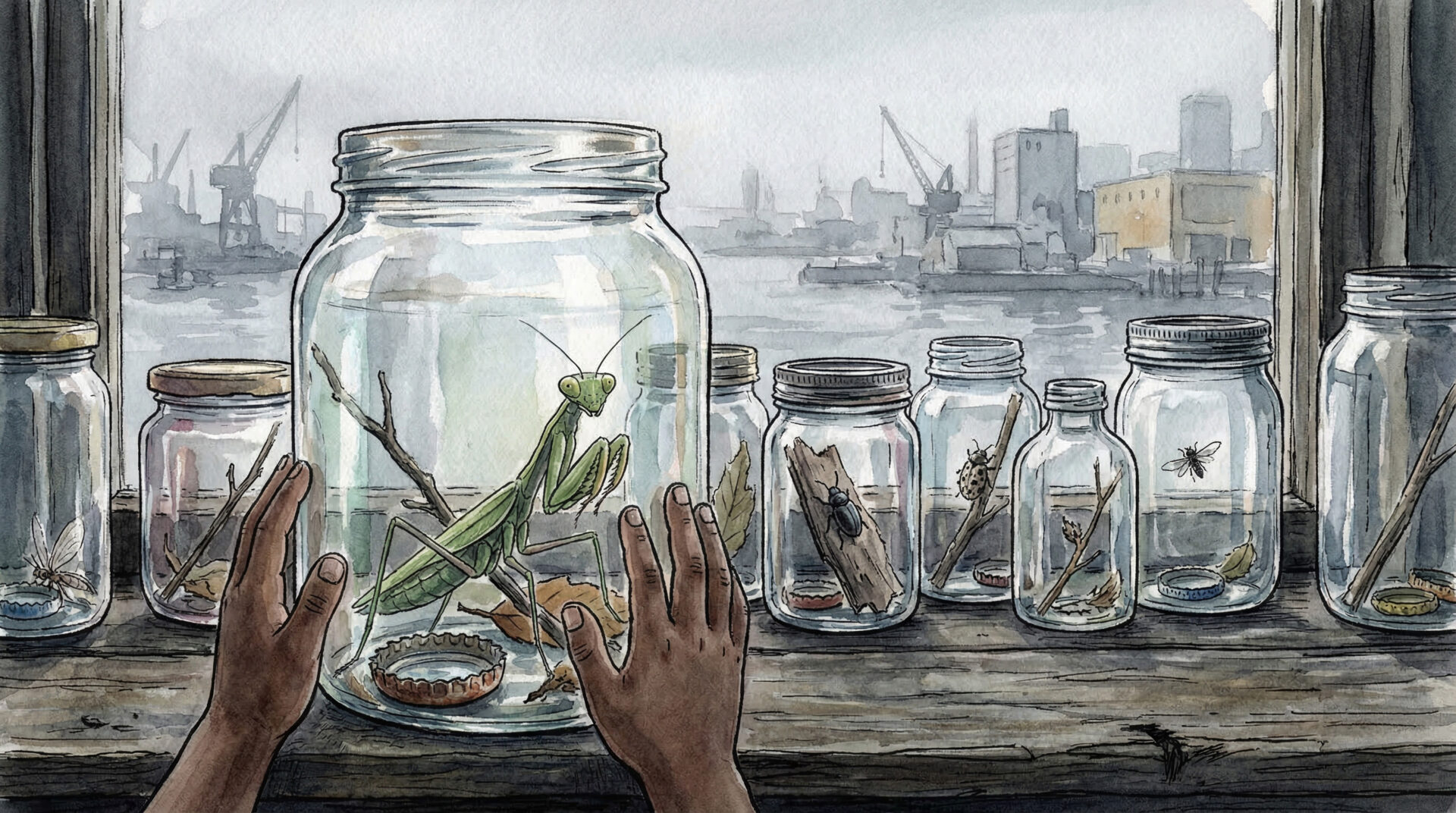
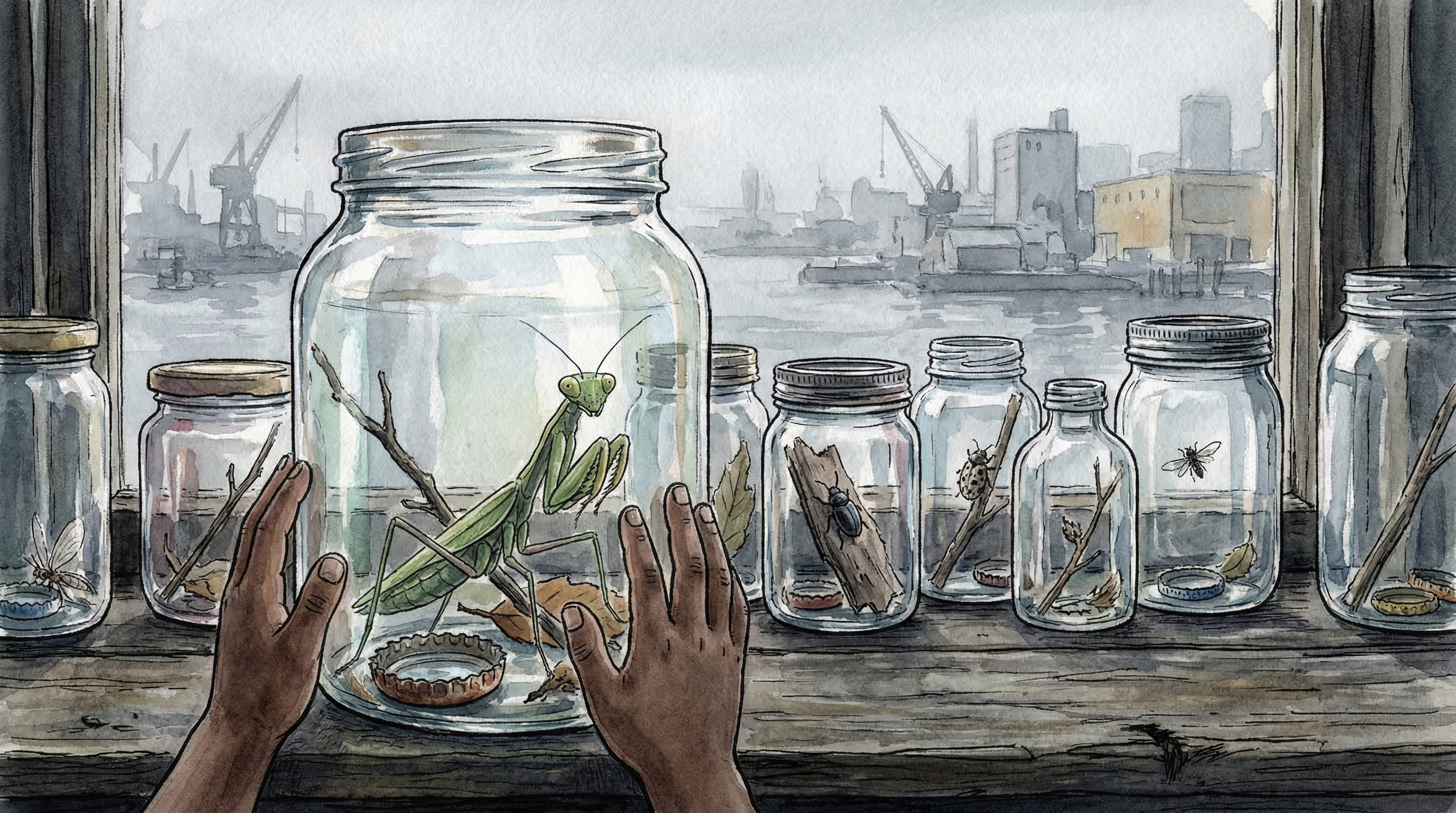
Sami watched through the glass. The jar was a large one — his aunt had found it at the market on Mercy Row, a pickle jar with a wide mouth and a metal lid he’d punched holes in with a nail. Inside: a stick for climbing, a bottle cap of water, and Madame, who had been in the jar for three weeks and had eaten eleven crickets and showed no signs of wanting to leave.
Mantis religiosa. The European mantis. Not the largest species — that was Ischnomantis gigas from Africa, which could reach sixteen centimeters — but the most elegant. The triangular head that swiveled like it was on a bearing. The compound eyes that reflected light in a way no other insect’s eyes did, a false pupil that followed you, that seemed to be looking back.
She was looking back at him now. The cricket was half finished.
“Good morning,” Sami said.
The mantis turned the cricket and continued.
From the kitchen, the sound of his aunt running water and the small radio she kept on the counter. The radio talked all morning in a voice that was mostly calm and sometimes not calm. Sami had learned the difference between the calm voice and the not-calm voice the way he’d learned the difference between Carabidae and Chrysomelidae — by paying attention to the details. The calm voice talked about weather and transit and something called the municipal authority. The not-calm voice talked about numbers and facilities and a word that sounded like graduation but didn’t mean the thing it meant at school, or the thing it used to mean at school, before the school closed.
“Sami. Breakfast.”
He checked the other jars. Nine of them on the windowsill, arranged by order of collection. The Carabus nemoralis — the forest ground beetle, the good one, the one that shouldn’t be in the city — was under its leaf. The two Nebria brevicollis were in their usual corner, mandibles touching, which might be fighting or might be talking; he hadn’t decided yet. The Amara aenea, the small bronze sun beetle he’d caught last week by the loading dock, was on its piece of bark. He’d have to find more springtails for it. Sun beetles liked springtails.
He went to the kitchen. His aunt had made canjeero and there was tea with milk and a glass of orange juice that was probably not real orange juice because real orange juice was expensive, but it was orange and it was juice and it came in a carton with a picture of a tree on it.
“Did you feed her?” his aunt said.
“She’s eating now.”
“I don’t want to know the details.”
“She started at the head. She always starts at the head. It’s the most —”
“I said I don’t want to know.” But she was smiling, or almost. His aunt’s smiles were small and quick, like something she kept in her pocket and took out briefly to check that it was still there. “Eat.”
He ate. The canjeero was good — spongy and sour, the way his mother used to make it, except different because his aunt’s hands were different and hands changed the bread. His mother’s hands had been softer. His aunt’s were longer and harder and had small scars on the fingertips from needles and scissors.
“I found a beetle yesterday,” he said. “A Carabus nemoralis. A forest ground beetle.”
“You told me.”
“I didn’t tell you about the legs. It has six legs, like all Coleoptera, but the tarsi — that’s the foot parts — they have five segments each and the second and third segments have adhesive pads. That’s how it climbs. I drew it.”
“You draw everything, macalin.”
He did. The notebook was on the table next to his plate. He opened it to the page. The beetle was there in pencil, seen from above, the way the field guides showed them — elytra spread, wings extended, legs arranged symmetrically. He’d labeled the parts: pronotum, scutellum, metathorax, femur, tibia, tarsus. He’d measured it against the edge of his ruler. Seventeen millimeters. He’d noted the date, the location (Lot 4, between Warehouse 11 and the fence), the time (3:47 PM), the weather (overcast, no rain, wind from the harbor).
His aunt looked at the drawing. She always looked. She didn’t understand why the parts needed names or why the names needed to be in Latin or why the time and the weather mattered, but she looked, every time, and she held the notebook carefully because the pages were thin.
“The legs are good,” she said. “The legs are always the hard part.”
“His left front leg was missing. The tibia. I don’t know what happened to it. Maybe a bird. Maybe it got caught. But he was still walking. Five legs instead of six.”
“He’ll manage.”
“Can they grow back? Legs?”
“I don’t think so.” She was putting on her coat, checking her bag, the movements she made every morning that were always in the same order because his aunt did things in order. Coat, bag, scarf, keys. “Some things you just have to work with what you have.”
She was quiet for a moment, folding her scarf.
“My grandmother — hooyo’s mother — she used to tell a story about a beetle,” his aunt said. She wasn’t looking at him, her fingers folding the fabric the same way they always did. “A big green beetle that lived by the river back home. And every year the river flooded. Every year the water came up and covered everything — the rocks, the mud, the beetle’s whole world, all of it under water. And every year the water went down and the beetle was still there. Same beetle, same place. She said the beetle didn’t fight the water. Didn’t try to swim or run. Just grabbed on to something and waited for the water to be done.”
“What did it grab?”
“A rock, I think. Or a root. I don’t remember.” She checked her bag for her keys. “Anyway, it held on. That was the story.”
She poured his milk. Set the glass next to his plate. Kissed the top of his head, the way she always did, quick, her lips dry and warm.
“Stay on this side of the Row. Don’t go past the loading docks. Home before dark.”
“I know.”
“I know you know. I’m telling you anyway.”
The door closed. He heard her boots on the stairs, then the street door, then nothing. She walked to work in the morning — he knew the direction because he’d watched from the window, north along Mercy Row toward the big building at the Processing Zone where she worked. She said she helped people who were waking up. He imagined an alarm clock, a very large one, for people who had been sleeping a long time.
He finished his breakfast. Washed his plate the way she’d taught him — soap, water, rinse, rack. Then he got his notebook and his magnifying glass and the empty jar with the lid he’d prepared last night, in case he found something, and he went outside.
Mercy Row in the morning smelled like the chai from the cart on the corner and the harbor underneath it. The harbor was always there — salt water and something darker, something metal, the smell of big things rusting in the wet. Sami had decided that Driftwood smelled like the inside of a can that had been left out in the rain. The Warrens, where they’d lived before, had smelled like Aunt Idil’s fabric shop — warm, close, full of things. Driftwood smelled like the opposite of things. It smelled like the spaces between things.
The community center was four blocks south. The woman who ran the classes, Madame Konaté, had set up the room with the big table and the colored pencils and the map of the world on the wall. Six children today. There had been more before the summer — Sami remembered eight, then seven, then six, and now sometimes five.
Yusuf was at the far end of the table. Yusuf was twelve and had been coming to the center since before Sami started. He used to talk a lot — Sami remembered this, the fast voice and the big hands moving while he talked, explaining things about football that Sami didn’t understand but liked listening to because the rhythm was nice. Yusuf didn’t talk anymore. He sat at the end of the table and drew circles on his paper, one inside the other, and his right hand held the pencil and his left hand stayed under the table.
Sami had seen the left wrist once. Two weeks ago. Yusuf’s sleeve had ridden up and there was something there, under the skin, that moved. Not much — a slow ripple, the way water moves when something underneath it shifts. It looked like the Tenebrio molitor larvae that Sami kept in a jar at home, the mealworms, the way they moved under the bran when you shook the container. Except it was under Yusuf’s skin and Yusuf had pulled his sleeve down fast and looked at Sami and Sami had looked away.
He understood about not wanting to show people things. He had a scar on his knee from when he fell on the pier last month and he didn’t show people that either.
Madame Konaté was talking about rivers. The big rivers — the Niger, the Congo, the Nile. Sami drew in his notebook while she talked. He was drawing yesterday’s forest ground beetle again, from memory this time, trying to get the missing leg right. The missing leg was important because the drawing had to show what was real, not what was supposed to be there. Five legs. That was what the beetle had and that was what the drawing should have.
“Sami.”
He looked up.
“What’s the longest river in Africa?”
“The Nile,” he said. “6,650 kilometers.” Then he went back to the drawing, because the trochanter joint where the missing leg would have attached was tricky and he wanted to show the socket without the leg, which was a thing he’d never drawn before and required a different kind of line.
At eleven the class ended and Sami went to the lots.
The lots were between Warehouse 11 and Warehouse 14, and they were the best place in Driftwood.
Nobody used them. They were too small for building and too broken for parking and too far from the active piers for the fishermen to care. The concrete had cracked years ago and the weeds had come up through the cracks — first the grasses, then the Taraxacum (dandelions, which were not just weeds but actual plants with actual uses that nobody in Driftwood seemed to know about), then the Buddleja bushes, which attracted moths, which attracted spiders, which attracted everything else.
Sami had mapped the lots the way the field guides said to map a habitat: grid system, one-meter squares, marked with stones at the corners. The field guides were his father’s — three of them, old ones with real paper pages, bought before Sami was born. His father had liked insects too, or had liked them enough to buy the books, and they were the thing Sami had taken from the apartment when they moved. He didn’t have string for proper quadrats, but the stones worked. He had fourteen squares mapped across Lot 4 and eleven across Lot 6, which was wetter because a pipe leaked somewhere and made a puddle that never dried.
He lay on his stomach at the edge of Square 7. The concrete was warm from the midday sun, the weeds rising around him like a forest seen from the floor. At this level the world was different. You couldn’t see the warehouses. You couldn’t see the road. You could see the stems and the soil and the things that moved through the soil, and if you were still enough, if you held your breath and didn’t move your hands and let the ground forget you were there, the things came out.
The spider came first. A Pardosa — a wolf spider, small, fast, carrying an egg sac on her spinnerets. She moved across the concrete in the quick stop-start pattern that wolf spiders used, the front legs testing the surface before the body committed. Sami watched her cross Square 7 and disappear into the crack where the concrete met the old foundation of something that had been a building once.
Then a beetle. Not his forest ground beetle — smaller, rounder, a Coccinella septempunctata, a seven-spotted ladybird. Common. He’d drawn four of them already. But he watched it anyway because you didn’t stop watching just because you’d seen the species before. Every individual was different. This one had a spot on the left elytron that was slightly elongated, more oval than round. He’d note it.
He opened his notebook. Drew the ladybird in quick lines — the pronotum, the elytra, the seven spots, the oval anomaly. Noted the date, the location, the time. The pencil was getting short. He’d need to sharpen it when he got home. His aunt kept the sharpener in the kitchen drawer, the one with the rubber bands and the batteries and the things that didn’t have another place.
A sound from the road — the low engine of the van. Sami knew the sound without looking up. It was a deeper sound than the cars, a sound that sat in the chest, and it came at different times on different days but always from the same direction, from the gate of Warehouse 11. He looked up.
The van was stopped at the warehouse’s loading bay. The rear doors were open. Two people in white coats came out of the warehouse carrying something on a stretcher, covered with a sheet. The sheet was the kind that didn’t have a pattern — plain, off-white, the kind the hospital on Mercy Row used, or the kind the clinic used, the flat kind that didn’t mean anything except that something was underneath it and you weren’t supposed to look at what.
The people in white coats put the stretcher in the van. The doors closed. The van drove away, toward the north, toward the Processing Zone.
Sami went back to the ladybird. The ladybird had moved — it was on the stem of a dandelion now, climbing, its legs finding the tiny hairs on the stem that acted like a ladder. He adjusted his drawing to show the new position. He noted the time: 1:23 PM. The van had taken about three minutes.
The afternoon was for crickets.
Madame needed to eat. Madame always needed to eat — mantises had metabolisms that required feeding every two to three days, and Madame was large and active and had eaten her last cricket this morning at 6:41 AM. Sami needed to catch at least two, one for tonight and one for tomorrow, because his aunt worked late on Tuesdays and he’d be doing the evening feeding alone.
Crickets lived in Lot 6, near the wet patch, because crickets liked moisture and organic matter and the pipe leak had created a small ecosystem — algae, moss, decomposing leaves, and the Gryllus campestris that lived in burrows at the base of the wall. Field crickets. Fat, dark, not fast if you knew how to move.
He knew how to move.
The technique was patience. You sat by the burrow and you waited. The cricket was inside, listening. It could feel vibration through the ground — any step, any shift in weight, and it would stay down. But if you were still, really still, the way Madame was still before she struck, the cricket forgot about you. Its world was small. Its memory was shorter. Three minutes, sometimes four, and the antennae came out of the hole, testing the air, and then the head, and then the body, and you brought the jar down fast and clean over the opening and the cricket was inside.
He caught three. Put them in the jar with the punched lid and set the jar in his bag.
He was walking back through Lot 4 when he found the beetle.
It was on its back in a shallow pool of rainwater that had collected in a dip in the concrete — a Pterostichus melanarius, a black ground beetle, common, legs waving slowly in the air. The water was only a few millimeters deep but the beetle couldn’t right itself. The elytra were wet, heavy, and the surface underneath was smooth concrete with nothing to grip.
Sami knelt. He extended one finger and placed it against the beetle’s ventral side — the underside, where the legs joined — and the beetle grabbed on, all six tarsi gripping his skin, and he turned his hand over slowly and the beetle was right side up on his palm.
It sat for a moment. The antennae moved. The legs tested his skin. Then it walked to the edge of his hand and dropped off onto the concrete and went into the weeds, fast, the way beetles went when they’d been reminded that the world was large and wet and not designed for them.
Sami dried his hand on his trousers and made a note.
The walk home took him past Warehouse 11. The loading bay was closed. The lights inside were on — they were always on, the same color, a flat white that didn’t change between day and night. He had never been inside. His aunt had said the buildings were for people who were sleeping and he shouldn’t go in because you didn’t go into places where people were sleeping because it was rude. This made sense. He didn’t like being woken up either.
Through the small window, if you looked, you could see shapes. Rows of something — beds, maybe, or the pods he’d heard Madame Konaté mention once, the kind the news talked about. The shapes were the same size and the same distance apart and they went back further than the window let him see.
He turned onto Mercy Row. Almost home. The lady next door was at her window, the way she always was — sitting in a chair pulled up to the glass, looking out at the street. She didn’t blink. Sami had watched her for four minutes once, counting the seconds the way his aunt had taught him — one-one-thousand, two-one-thousand — and the lady hadn’t blinked. Her eyes were open and looking at something that wasn’t the street, something further away or closer, and her hands were on the armrests of the chair and they didn’t move either.
He stopped on the pavement below her window.
“Hello,” Sami said.
The lady’s eyes moved to where he was. The looking and the moving were not the same thing — the movement was mechanical, the eyes adjusting, but there was nothing behind the adjustment. He knew the difference. It was like the difference between a living beetle and a pinned specimen: the body was in the right position but the thing that made it a beetle was not.
“My name is Sami,” he said. “I live upstairs.”
The lady’s mouth moved. Not words. Just her lips opening a little and closing again, like she was trying to say something but couldn’t find it.
He went upstairs.
The apartment was warm. His aunt had left the radiator on, which she did when she worked late, because the building got cold after four and she didn’t like him to be cold. He set his bag down. Put the cricket jar on the kitchen counter. Went to the window.
The jars were in a line on the sill, nine of them, the glass catching the late afternoon light. Through the glass: beetles, moths, the mealworms in their bran, Madame on her stick, clean and patient, her forelegs folded, her false-pupil eyes watching him come.
He checked each jar. The forest ground beetle was active — walking the perimeter, the way it did in the afternoons, the five remaining legs working in a pattern that was different from the six-legged pattern but equally precise. The body had adjusted. The circuit was the same; the gait was new.
The Nebria brevicollis pair were still in their corner. Mandibles touching. He marked this in his notebook: Day 4 of mandible contact. Still can’t tell if fighting or communicating. Need more observation.
The moth — Noctua pronuba, a large yellow underwing — was on the side of the jar, wings closed, the dull brown of the upper wings hiding the bright orange of the lower ones. A disguise. The moth looked like bark until it flew, and then it was something else entirely, something you didn’t expect, and by the time you’d registered the orange it was gone. He liked that.
The Amara aenea.
He looked at the jar. The sun beetle was on its back. The legs were not moving.
He picked up the jar. Held it up to the light. The beetle was on the bark, upside down, the bronze elytra catching the sun through the glass. The legs were curled inward — all six, drawn tight against the ventral plates, the way beetle legs curled when the muscles contracted for the last time. The antennae were still.
He opened the lid. Touched the beetle with his finger. The body was hard and light, lighter than it had been alive, as if something had left that had weight to it.
He’d had the Amara aenea for nine days. He’d fed it. He’d given it water. He’d put fresh bark in the jar two days ago. The ventilation holes were the right size — he’d measured them against the field guide’s recommendations. He’d done everything right and the beetle had died anyway.
He sat on the floor under the window. He held the jar in his lap. The other jars were above him on the sill, catching the light, and he sat there for a while. He didn’t count the minutes.
“Sami.” His aunt, from the doorway. He hadn’t heard her come in. “Sami, I’m home. Are you hungry?”
He looked at her. She was still in her coat, her bag on her shoulder, her scarf the dark blue one she wore on Tuesdays. She looked at him on the floor with the jar in his lap and her face did something — not a smile, not a frown, something that moved through her features the way a current moved through water, there and then not there.
“The sun beetle died,” he said.
She set her bag down. Came to the window. Sat on the floor next to him, which was not something she usually did because her knees were bad and the floor was hard. She didn’t take the jar. She didn’t say anything about the beetle being in a better place, which other adults said about things that died and which had never made sense to him because the beetle had been in a jar and the jar was where he’d put it and there was no better place than the place someone had made for you.
“I’m sorry, macalin,” she said.
He put the jar back on the windowsill. He didn’t take the beetle out. He put the jar back in line with the others, between the Nebria pair and the moth. The lid stayed on.
His aunt put her hand on the top of his head. Her palm was warm and dry and large.
They sat on the floor for a minute. Then she said, “I’ll start dinner,” and got up, slowly, one hand on the wall.
He fed Madame at 7:12 PM.
The cricket went in through the lid. Madame’s head swiveled — the triangular face, the compound eyes with their false pupils, the antennae orienting toward the movement. The forelegs unfolded. The strike was fast — faster than Sami could see, faster than anything he’d ever timed, four hundredths of a second according to the field guide, which was faster than a human blink.
The cricket was in the forelegs. The mandibles started at the head.
He watched. The precision of it. The patience. The way she held the cricket and turned it, working systematically, the way his aunt folded fabric — find the edge, follow the edge, nothing wasted, nothing missed.
His aunt was in the other room. The news was on, volume low — the calm voice, not the not-calm voice, talking about something Sami couldn’t quite hear. Numbers. A district name he recognized. Something about capacity.
He watched the mantis eat. In the jar beside her, the forest ground beetle was walking its circuit on five legs. In the jar beside that, the Nebria pair were touching mandibles. In the jar beside that, the sun beetle was on its back in the light, and the light came through the glass the same way it came through all the jars, because the light didn’t know the difference.
The news stopped. He heard his aunt turn off the radio.
Madame finished the cricket. She cleaned her forelegs. The light through the jars was amber and the evening was coming and the beetles were in their worlds and the worlds were small.
Sami closed his notebook. He put the pencil on top of it. He went to brush his teeth, and on his way past the other room he saw his aunt at the dresser. She had the small drawer open — the one she kept closed, the one with the photograph in it. She was looking down at something in her hands. She didn’t see him. He kept walking.
He put on the pajamas she had laid out and got into bed. The sheets were clean because his aunt washed them every Sunday and today was Tuesday and they still smelled like soap.
He closed his eyes.
He could hear his aunt in the kitchen, doing the dishes. Water and the clink of plates. She was humming something, very quiet, that he almost recognized.
He dreamed about beetles. The forest ground beetle, walking on five legs. The ladybird, climbing. The sun beetle, bronze in the light. They moved through a field he’d never been to — wide, green, no concrete, no warehouses, no glass. The river was there but it was small and the beetles crossed it easily, their legs carrying them over the water the way legs carried them over everything, because that was what legs were for, and they had enough of them, and the field went on.