The chalice was the last thing to put away.
Father Mihail dried it with the cotton cloth he kept folded in his cassock pocket. The same cloth, the same pocket, for eleven years. The chalice was not valuable. Plated, not gold, with a stem that had been soldered once where the base met the cup. He dried it the way he dried it every Sunday: slowly, turning it, the cloth following the curve. Then he wrapped it in its linen, set it in the case with the disc and the spoon, and closed the lid.
The case went into the cupboard that wasn’t his. The Church of the Redeemer, Lutheran, mostly empty now, was run by a kind pastor named Eriksen who charged them nothing for the use of the hall. She kept the cupboard unlocked for him. His things on the top shelf. Their things on the lower three. It was an arrangement that worked because both sides were careful not to need more space than they had.
He folded the altar cloth. It was embroidered with a cross and an image of Maica Domnului, done by a woman in his congregation who had died in April. Her stitches were uneven. The gold thread she’d used was not real gold. He folded it the way he always did, into quarters, and placed it on top of the case.
Outside, rain. It had been raining when the liturgy began and it was raining now. His congregation, fourteen people this morning, which was good, had gone home. Some Sundays it was nine. Mrs. Aldea had stayed to sweep, but he’d sent her away because her hip was bad and the floor wasn’t dirty. He’d sweep it himself. Later.
He unstacked the folding chairs from their rows and leaned them against the wall. Twelve chairs. He’d stopped putting out more than sixteen because the empty ones changed the room. Better to add a chair for a surprise than to stare at six empty seats through the whole liturgy. He’d learned this in his second year. A room should hold the people who are in it, not the people who aren’t.
He was putting the icon of St. Parascheva into its padded bag, working the zipper around the frame where it always caught, when the door at the back of the hall opened.
Not a parishioner returning for forgotten gloves. The door opened all the way, held open, the rain louder for a moment. Then it closed and the footsteps came down the aisle between the stacked chairs. Heavy, deliberate. A big man’s walk.
Father Mihail turned.
“Părinte.” The old word. Father.
He was wet. His jacket was dark with it, the shoulders soaked through, his hair plastered flat. He stood at the end of the aisle with his hands in his pockets and water running off his sleeves onto the floor, and his face was doing the thing the priest remembered from years ago. The wide, bright expression that meant everything underneath it was locked.
“Radu,” Father Mihail said.
“I was in the neighborhood.”
“You were in the neighborhood.”
“I was.”
“In the rain.”
“It’s always raining.”
The priest looked at him. Thirty-four years old now. Bigger than the last time. Not taller, denser, the neck thicker, the shoulders wider. The boy. He was not a boy. He had not been a boy for a long time.
“You’re soaking wet,” Father Mihail said. “Come.”
The kitchen belonged to the Lutherans and their women’s auxiliary and a Tuesday-night grief support group whose pamphlets sat in a rack by the door. It had a kettle and cups and a tin of tea that Pastor Eriksen kept stocked for him. He filled the kettle. Set out two cups.
Radu sat at the table. He’d taken off his jacket and hung it on the back of the chair and was sitting with his arms on the table, his hands wrapped together. The kitchen was small and he took up most of it. He’d always been like that. Even as a young man, before the bulk, he’d had the quality of filling a room too completely. Back then it had been anger that took up the space. Now it was something else. Discipline, maybe. Or the effort of discipline.
“How long?” Father Mihail said.
“Since I was here? Four years. Five.”
“Five.”
“The liturgy at Pascha. 2061.”
“You came for Pascha.”
“I liked the singing.” A pause. “And I missed the incense. You can’t get that smell anywhere else. I’ve tried.”
“The incense is the cheap one from the supplier in the Warrens. It’s not even real frankincense.”
“I know. I still missed it.”
He poured the water. The kettle was Lutheran and efficient, nothing like the old briki he used at home. He set the cup in front of Radu. Sat down across from him.
Radu picked up the cup. His fingers were stiff around the handle, the grip awkward, and he shifted it to hold with both hands instead. The priest noticed the way the fingers curled. He didn’t look twice.
From the jacket on the chair, a buzz. Radu’s phone. He reached back, pulled it from the pocket, glanced at the screen, and silenced it. Put it on the table face down.
“How is your practice?” the priest said.
Radu’s face changed. The brightness shifted into something more genuine. The pleasure of being asked a real question by someone who actually wanted to hear the answer.
“Good. It’s good, Părinte.” He held the cup with both hands. “I sat a seven-day sesshin last autumn. At the center in Ashfield. The one near the old school.”
“Seven days.”
“Just sitting. Five in the morning to nine at night. Forty-minute rounds, ten-minute walking periods. You eat in silence. You sleep in the zendo. No talking, no reading, no phones.”
“And this is restful.”
Radu almost smiled. “It’s the opposite of restful. It’s the hardest thing I do all year. My knees feel like they’re going to come apart by day three. My back. My hip flexors. You’d think after six years of sitting I’d be past the physical complaints. You’re never past them.”
“So you sit in pain for seven days.”
“I sit with pain for seven days. There’s a difference.”
“There is.” Father Mihail drank his tea. “The Desert Fathers would agree with you. Abba Moses said, ‘Sit in your cell and your cell will teach you everything.’ He didn’t say the teaching would be comfortable.”
“That’s basically our instruction. Sit. Stay. Don’t move. And when your knee is screaming and your back is on fire and your mind is telling you seventeen reasons to get up, you don’t get up. You stay.”
“What do you do with the pain?”
“You note it. ‘Pain.’ You feel where it is. You notice it’s not static. It shifts. It pulses. It has a shape, and the shape changes. Sometimes it gets worse and sometimes it dissolves entirely and you realize you were fighting it and the fighting was most of the pain. You don’t do anything about it. You just watch.”
“And the thoughts?”
“Same. A thought comes up. You label it. ‘Thinking.’ Or if you can be more specific: ‘planning.’ ‘Remembering.’ ‘Worrying.’ The label is the interruption. It’s like tapping someone on the shoulder and saying, ‘I see you.’ The thought doesn’t like being seen. It loses its power.”
He set down his cup. “What you’re describing is what the fathers in the Philokalia were doing. Watchfulness, they called it. A bad thought comes, an impulse, anger or desire or whatever it is, and you see it arrive. You name it. You don’t follow it. You let it come and let it go.”
“You say Doamne Iisuse?”
“Yes. The Jesus Prayer.” He said it in Romanian first, because that was how it lived in him. “Doamne Iisuse Hristoase, miluiește-mă. Lord Jesus Christ, have mercy on me. Over and over. You anchor the attention in the prayer so the thought has nowhere to land.”
“In zazen we use the breath. Or a label. The thought comes up, you label it, you come back to the breath. The breath is the anchor.”
“Yes. The mechanics are very similar. One of the old monks on Sinai described it as standing at the door of your heart and not letting the thought in. Simple as that. Doesn’t mean easy.”
“We’d say: you see it, and you let it go.”
“There’s a difference.”
“Is there?”
“Yours goes past you. Ours goes back to God.”
Radu tilted his head. Considering. “That’s the destination question, though. Not the method question. The method is the same.”
“I’ll give you the method.”
“That’s very generous, Părinte. You’ll give me the method.” He was grinning. The old grin. The boy who’d come into the priest’s office smelling of smoke and shown, underneath the anger, a mind that could keep up with anything.
The priest tilted his head. The old argument, the familiar ground. He’d missed this. The young man had always been sharp. Sharper than he let on, sharper than the body suggested. People looked at the size of him and assumed a certain kind of mind. They were wrong.
“Tell me about your teacher,” Father Mihail said. “You have a teacher?”
“Sensei Barlow. At the center. She’s been practicing for thirty years. Sōtō lineage, through the San Francisco Zen Center.”
“And she guides you the way a duhovnic would? She knows your practice, your struggles, your particular patterns?”
“It’s different. She gives instruction. She does dokusan — private meetings — during sesshin. But it’s not like what you and I had. It’s less…” He searched for the word. “Less personal. She’s pointing at something. I look where she points. The pointing isn’t the relationship.”
“And that’s enough for you.”
“It’s what the practice is. Zen is not about the relationship between teacher and student. It’s about what the student sees when the teacher stops talking.”
“Hmm.” Father Mihail made the sound he made when he disagreed and wasn’t ready to say so. Radu heard it. He’d always heard it.
“Don’t ‘hmm’ me, Părinte.”
“I’ll hmm whoever I like. I’m sixty-three years old. I’ve earned the hmm.”
Radu laughed. A real laugh, sudden, and the priest felt something in his chest loosen. The boy’s laugh. Still in there.
The phone buzzed on the table. Radu picked it up without looking at the screen and silenced it. This time he put it in his pocket.
“For us,” Father Mihail said, “the thought arrives and you turn back to the prayer. Back to Christ. The prayer is not empty. It’s addressed to someone. You’re not just watching your mind work. You’re turning your attention toward a living presence. The stillness we practice, liniște, hesychia, is not the stillness of an empty room. It’s the stillness of a room where someone else is with you.”
“And for us, the stillness is the room. Original mind. Before you add anything to it. Before you add God, before you add self, before you add the idea that there’s someone watching and someone being watched. There’s just this.” Radu opened his hands. A brief gesture, palms up. “Just awareness. Not awareness of something. Just awareness.”
“And this is enough?”
“Yes.”
“I wonder.”
“You always wondered.”
“I still do.” Father Mihail smiled. “You left my church for a wall and a cushion. I’m entitled to wonder.”
“Părinte, your church is wonderful. The liturgy is the most beautiful thing human beings have ever made. I mean that. The entire liturgy. The way it moves. The way it builds. I’ve sat through a hundred liturgies and I still don’t understand how it works, how the whole room changes over the course of an hour. It’s architecture. Spiritual architecture.” He paused. “But when I sit zazen, something happens that never happened for me in prayer. The labels stop. Not just the bad ones, anger, fear. All of them. ‘Radu’ stops. ‘Christian’ stops. ‘Man’ stops. There’s just the breathing and the wall and whatever this is.” He touched his chest. “And it’s enough. It’s more than enough. It’s the only place I’ve ever found where the noise stops.”
The priest looked at his hands. The tea was cooling. He understood the appeal, even if he didn’t share it. The practice that asks nothing of you except your attention. No creed. No sacrament. No God who might or might not answer. Just the breath and the wall and whatever this is.
He understood the appeal. He did not share it. For the priest, the stillness was always full. The prayer was always addressed. The room always had someone in it.
“The noise,” Father Mihail said. “You said the noise stops.”
“On the cushion. In sesshin. When the practice is deep.”
“And when you get up?”
Radu looked at him. The brightness flickered. Just for a moment. Like a lamp in wind.
“It comes back,” he said.
“Yes.”
“But quieter. The reactivity gets less. I can feel something arise and I don’t have to follow it. I have a choice. That choice is the whole practice.”
“And it works?”
“Most of the time.”
“Most of the time.”
“Nothing works all the time, Părinte.”
“No,” Father Mihail said. “Nothing does.”
A silence. Radu drank his tea. The priest watched his hands on the cup. The way the fingers wrapped tight. He noticed, the way he always noticed, without reaching for the meaning yet. A priest learns to see before he interprets.
“But tell me about the liniște,” Radu said. “About what you practice. Because the way the fathers describe the interior life, it’s not that different from what I’m doing. The mechanics are the same. Watch the mind. Don’t follow the thoughts. Find the stillness underneath.”
“The mechanics are similar. The destination is different.”
“Maybe.”
“Not maybe. The Desert Fathers weren’t trying to find an empty room. They were trying to find God in the room. You clear away the noise, and what’s left isn’t nothing. What’s left is a presence you couldn’t hear over the noise.”
“And if the presence isn’t there?”
“It’s always there. The question is whether you’re willing to be found by it.”
“Found,” Radu said. “Not finding. Found.”
“Yes. The prayer is not you reaching for God. It’s you standing still long enough for God to reach you.”
“Părinte, with respect, I think that’s a beautiful idea. But in practice, on the cushion, there is no difference between sitting still to find something and sitting still to be found. The body doesn’t know the theology. The body just sits.”
In his pocket, the phone buzzed again. Radu reached in, and this time the priest heard the click of it being turned off. Radu’s face didn’t change. He put both hands back on the table.
“The body knows more than you think,” Father Mihail said. He paused. “Some things don’t heal in silence, Radu. The things people did to us — those need a person.”
Radu went quiet. He drank his tea. His hands, around the cup, were tight.
The priest noticed. He noticed the way you notice a change in the light. Not sudden, not dramatic. A shift. The hands had been open a moment ago, palms up, the gesture of just-this. Now they were clenched around ceramic, the knuckles white.
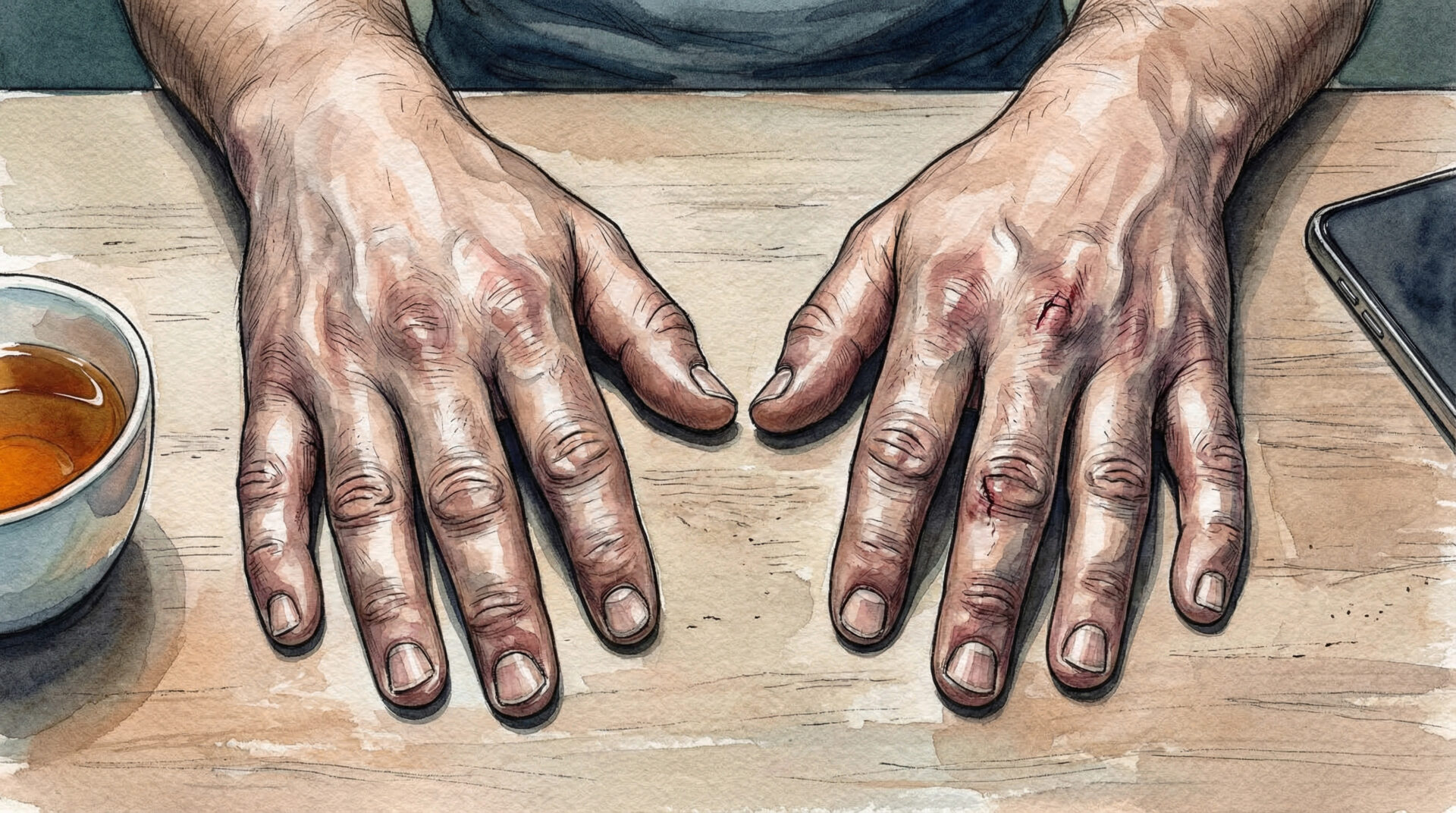
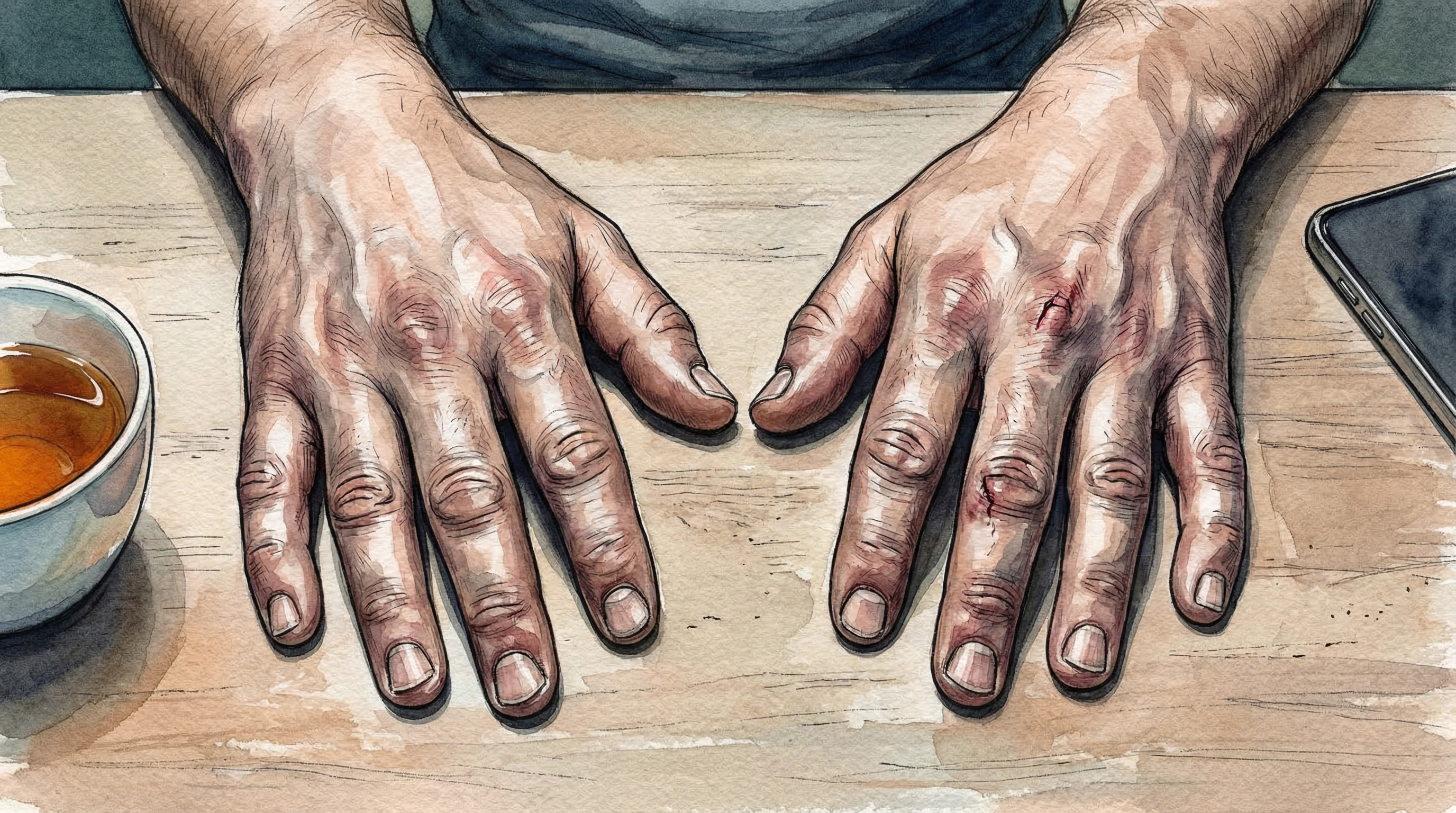
Not white. Discolored. The skin across the right hand was swollen, darker than it should be. The left was the same.
The priest looked at the hands and then looked at Radu’s face and Radu was watching him look.
Neither of them said anything.
The priest picked up his cup. Drank. Set it down.
“More tea?” he said.
“Please.”
He refilled the kettle. The sound of the water filling and the element beginning to heat. Outside, the rain. He stood at the counter with his back to Radu and his own hands were steady, and he was grateful for that, because something had just walked into the room and sat down between them and it was not going to leave.
He brought the cups back. Sat down.
“You were asking about liniște,” he said.
“I was.” Radu took the cup. His hands were below the table now, the cup resting on its surface, his fingers only on the rim. He’d moved them. He knew the priest had seen.
“Liniște is a word I’ve never been able to translate. Not into English, not into Greek, not into anything. The closest is hesychia, which is the Greek the fathers used, but even hesychia doesn’t have the warmth. Liniște is… you know what it is. You grew up hearing it.”
“My grandmother used to say it. Liniște. When we were loud. When the house was chaotic. Liniște, copii.”
“And what did she mean?”
“Quiet down. Be still.”
“Yes, but underneath that. She wasn’t asking for silence. She was asking for a condition. The condition of a room where no one is fighting, no one is performing, no one is running. Just the room. Just the people in it. Settled.” The priest paused. “Even the sound of the word does it. Say it.”
“Liniște.”
“You see? It begins soft and it ends in a whisper. The word itself is the thing it describes.”
Radu was looking at him. The brightness had quieted. Not gone. Dimmed, the way a flame dims when the oxygen changes.
“I’ve been looking for that my whole life,” Radu said. “That condition. That settled thing. I thought Orthodoxy was it. Then I thought zazen was it. Sitting in sesshin, by day five, day six, there’s a place where the thoughts thin out. The labels stop sticking. There’s just space. Like the silence between notes in music. And the silence gets wider and the notes get quieter and at some point you realize the silence was always there. The notes were just covering it up.”
“And what happens in the silence?”
“Nothing happens. That’s the point. Nothing needs to happen. You’re just there. Sitting. Breathing. Alive.” He paused. His jaw worked, briefly, the muscles at the hinge tightening and releasing. “It’s the only time I don’t feel like I’m running from something.”
The priest held still. The sentence sat in the room. He let it sit. He did not reach for it. He did not ask the question that any competent counselor would ask, the obvious question, the one that would crack the conversation open like a fist through glass. He waited. He breathed. He practiced what he had been practicing for thirty years, which was the discipline of the open door. You don’t pull someone through. You hold the door and you wait.
“Running from what?” he said. Soft. Not pressing. The voice you’d use near something that might startle.
“From the usual. The thoughts. The patterns. The old stuff.” Radu waved his hand. The gesture was too loose. Too casual. “You know what I carried in here, Părinte. You’ve heard all of it.”
“I heard what you told me.”
“You heard everything.”
“I heard what you told me. No one tells everything.”
Radu looked at him. A beat. Two. Something behind his eyes, working, assessing. Then the brightness came back on, the animation, the deflection.
“So tell me about the stages. The way a thought takes hold. The initial arising, that first flicker, that’s contact. And the coupling, where the mind grabs on —”
“Radu.”
“— that’s the hook, the feeling-tone, and then consent, where you actually go with it, and after that you’re caught, you’re acting from the impulse and not from —”
“Radu.”
He stopped.
“Your hands,” Father Mihail said.
The room changed. Not a sound, not a movement. The quality of the air. Like the barometric pressure dropping before a storm.
Radu’s mouth closed. His jaw set. The muscles in his forearms, visible below the rolled sleeves, went rigid.
“I hit something,” he said. “At the gym.”
Father Mihail said nothing.
“The bag. The heavy bag. I was working combinations and I wasn’t wearing wraps and —”
“Radu.”
The third time. Father Mihail said it the way he’d said it when this man was twenty-two and sitting across from him in the apartment that used to serve as his church office, in the years when Radu would come in smelling of smoke and other people’s fear. The priest would say his name, just the name, and wait. The name was not a question. It was not a command. It was a door left open. The person on the other side could choose to walk through or not.
Radu put the cup down. His hands were flat on the table. The swelling was visible now, exposed. The split skin on the right knuckles. Something dark in the creases that might have been blood that hadn’t washed out all the way.
He looked at his hands on the table as if they belonged to someone else. As if he was studying them from the same careful distance he’d been describing on the cushion. Noting. Labeling. ‘Hands.’
“My father came back,” he said.
The priest breathed in. Breathed out. The breath came from below the chest, from the belly, the way you breathe when the ground shifts and you need to stay standing.
“When?”
“Three weeks ago. He came back. To Vesper. After fifteen years. And she let him in.”
He. She. No names. The way Radu had always talked about them, from the very first confession. As if naming them would make them more present than he could stand.
“Fifteen years, Părinte. He left when I was nineteen. No. He didn’t leave. She threw him out. Finally. After the last time, when she was in the hospital for three days and I sat in the corridor because they wouldn’t let me into the room. I was nineteen and I sat in a corridor and I could hear her through the wall.”
The priest remembered. He remembered the confession. The young man’s voice in his office, flat the way it was flat now. Recounting the hospital corridor the way he’d recount a walk to the shops. The flatness itself was the tell. Anything delivered without affect was the thing that carried the most.
“And she let him back in,” Father Mihail said.
“She called me two weeks ago. Told me he was there. That he was different. Sober. Going to meetings. A different man, she said. He wants to make it right.”
“And you believed her?”
“I believed she believed it. That’s not the same thing.”
“No.”
“But she’s my mother. And she asked me to come. She said it would mean a lot to him. That he wanted to see me.” Radu’s voice was controlled. Measured. He was delivering information the way you deliver information to a doctor. Relevant history. Timeline. The facts.
“She wanted you to come tonight.”
“She’d been asking for a week. I kept saying I was busy. And tonight I ran out of excuses. Or I stopped wanting to find them.”
He picked up his cup. Set it down without drinking. Picked it up again.
“He was smaller than I remembered,” Radu said. “That was the first thing. Fifteen years and the picture in my head was this enormous man. The size of the world. And he was sitting in the kitchen and he was just an old man. Thin. His hands were shaking. Not from drinking. From age, or from whatever the drinking has done to him over the years. He looked at me and he stood up and he said my name and I felt…” He paused. “Nothing. I noted it. ‘Nothing.’ I was ready to feel something enormous and what I felt was nothing.”
“Sometimes nothing is the most enormous thing.”
“Maybe. We sat in the kitchen. The three of us. She made coffee. Turkish coffee, the way she always makes it. Three cups on the table. He talked about the program. The twelve steps. His sponsor. The work he’d done. The amends he wanted to make.”
“And you listened.”
“I sat across from him and I watched his mouth move and I noted my responses the way I’ve been trained. ‘Skepticism.’ ‘Anger.’ ‘Sadness.’ They came up and I labeled them and they passed. I was so calm, Părinte. I’ve never been that calm in my life. Six years of practice and it was all right there. Working. Exactly as designed.”
“And then you left.”
“And then I left. I thanked her for the coffee. I told him I’d heard him. I didn’t forgive him because you can’t forgive someone in an evening and mean it, and I won’t lie to him. But I shook his hand. I shook his hand at the door.” Radu looked at his own right hand on the table. “This hand.”
“That was the first visit.”
“That was Tuesday.”
“And tonight?”
Radu’s chest expanded. A deep breath, held, released slowly. The breathing technique. The practice, still running.
“Tonight I went back. Because she’d called yesterday and her voice was wrong. Not scared. The careful voice. The voice I grew up hearing. The one that means everything is fine and nothing is fine and please don’t ask.”
The rain was louder. Or the room was quieter. The priest couldn’t tell which.
“She was in the kitchen. Cleaning up. She had a cloth pressed to her cheek, held there like she was tired and leaning on her hand. But it was a wet cloth. And when she shifted it I could see the mark.”
He stopped. Swallowed. The Adam’s apple working in the thick neck.
“She said she bumped the cabinet door.”
The priest sat still. His hands were in his lap. He could feel the beating of his own heart, faster than it should be. He did not move toward Radu. He did not speak. He practiced what he had practiced for thirty years in rooms like this one, with people carrying things that could not be carried. Not performing stillness. Actually still.
“He was in the other room. Watching television. I could hear it through the wall. She was saying it was nothing and I could hear him in there watching television and she had a wet cloth on her face, Părinte, and it was exactly like it was before. Exactly. The cabinet door. She used to say the cabinet door when I was eight.”
“Radu.”
“I went in the room. I don’t remember what I said. I don’t think I said anything. He was sitting in her chair, the blue one, the one she sits in, and he looked at me. And he said —”
Radu’s voice cracked. Not loudly. A fracture in something load-bearing.
“He said, ‘She’s fine. Calm down.'”
The silence after the sentence was different from the silences that had come before. Those had been pauses. This was an absence. Something missing from the room. The priest could feel it in his sternum.
“I was calm,” Radu said. “That’s what I keep — I was calm. I felt the anger come up and I noted it. ‘Anger.’ Like I was taught. And it was enormous. It was the biggest feeling I’ve ever had. And I noted it and I watched it and I was calm.”
His breathing had changed. Shorter. Faster. The control thinning like ice in April.
“And then he stood up.”
The priest waited.
“And my body.” Radu looked at his hands. “Something happened. There was no thought. There was no noting. There was no space between the anger and my hands. The thing I’d been practicing for six years, the gap, the choice, the moment where you see the impulse and you don’t follow it. It wasn’t there. It was just —”
He pressed his fists against the table. The knuckles. The split skin. The hands that had been building themselves for exactly this moment for twenty years, since he was eight years old and too small and swore he would never be too small again.
“I hit him.”
The words came out flat. Dead.
“I hit him and he went down. And I hit him again. On the floor. And again. And I could hear — I could hear the sounds he was making and they were —”
His voice thickened. The articulateness dissolving.
“He was begging me, Părinte.”
He pressed his fists against his eyes. The damaged knuckles against his own face. The priest could see the tendons standing out in his forearms, the whole body clenching.
“He was on the floor and he had his hands up and he was saying please and I couldn’t stop. I couldn’t — my hands wouldn’t — I kept hitting him and he was bleeding and I could hear her behind me, she was crying, not screaming, just this sound, this —”
His face broke. The musculature that had been holding it in a recognizable shape all evening, the brightness and the animation and the careful composure, gave up. The brow collapsed. The mouth opened and what came out was not a word.
The sob came from below the diaphragm. From below the zazen and the noting practice and the six years of sitting with everything you want to run away from. It came from the body. From the eight-year-old’s body still alive in the thirty-four-year-old’s chest. It was ugly and mechanical and it shook him the way a seizure shakes, the big shoulders heaving, the hands that had done the thing gripping the edge of the table like the table was the only solid thing left.
Father Mihail moved.
Not thinking. His hand went to the back of Radu’s neck. The skin was hot and damp and the muscles beneath were like cable. He put his hand there and held. Not gripping. Resting. The weight of a hand. That was all. The weight of a hand on the back of a neck.
Radu’s head went down. His forehead hit the table and the sobs came in waves, each one wrenching something loose, the sound filling the borrowed kitchen. A man’s body breaking a seal it had maintained for hours or for decades. The sounds were not dignified. They were not the sounds of a person crying. They were the sounds of a body evacuating something it had been holding in the muscles and the jaw and the fists.
Father Mihail kept his hand where it was. He did not speak. He did not pray aloud. He prayed the way he always prayed, internally, the Jesus Prayer cycling through him the way his heartbeat cycled, continuous, effortless, the prayer that had become breath. His hand was on this man’s neck and the rain was on the roof and the tea was cold and the sound in the room was terrible and he did not move.
Minutes. He didn’t count them. At some point the sobs became breathing, and the breathing became slower, and the body under his hand stopped shaking and was just heavy. Pressed against the table. A man’s full weight given to gravity.
“I don’t know if he’s alive,” Radu said. Into the table. His voice scraped raw. “I left. He was on the floor and she was crying and I left. I didn’t call an ambulance. I don’t know if she called. I haven’t looked at my phone. I can’t.”
Father Mihail’s hand stayed.
“I don’t know, Părinte. If he’s dead. I don’t know if I killed him.”
The rain on the roof. The fluorescent buzz. The pamphlets in the rack by the door, for the grief support group that met here on Tuesdays.
“I came here,” Radu said. “I walked across the city and I came here.” A pause. A shuddering breath. “I don’t know why.”
Father Mihail closed his eyes. His hand on the back of this man’s neck. The heat of the skin. The pulse through his palm, fast, alive, the heart doing its work.
He knew why. He had known the moment Radu walked through the door. Not known what, but known why. The brightness. The animation. The theological conversation offered like a last meal. The hands hidden, then revealed, then the story, then the breaking.
He had come because there was a thing he needed that his practice did not have, that the silence could not give him, that sitting alone with his original mind could not provide.
He needed someone to receive it.
“Radu,” Father Mihail said. “Look at me.”
Radu raised his head. His face was ruined. Red, swollen, wet. The composure gone. No architecture left. Just a face.
“I need to check on him,” Radu said. “I need to call. I need to find out —”
“Yes. You do. And you will. But not yet.”
“Părinte —”
“Not yet. Listen.”
Radu looked at him. The eyes of a man who had run out of everything. The running and the sitting and the noting and the labeling, all of it spent, and what was left was a man on a chair in a kitchen looking at his priest.
Father Mihail stood. He went to the hall. The cupboard. Top shelf, next to the case with the chalice and the disc, a smaller case. He opened it. Inside, folded: the epitrahil. Purple cloth, gold thread, the crosses embroidered at intervals. He’d had it for twenty-six years. It had been placed over hundreds of heads. He took it out.
He came back to the kitchen. Radu saw what was in his hands. Something moved across his face. Recognition, and fear, and something under the fear that looked like thirst.
“You don’t have to,” Father Mihail said. “This is not about coming back. This is not about what you believe or what you practice or where you sit on Sunday morning. This is here, if you want it. That is all.”
Radu looked at the stole. At the priest’s hands holding it. At his face.
“I don’t know if I believe in it anymore,” he said.
“That is not what I asked.”
A long silence. The rain on the roof. The kitchen. Two cups of cold tea on a table in a Lutheran church in the Warrens.
“Părinte.”
The word came out broken in a way the language hadn’t been all evening. Father. Parent. The double weight of it, every ounce.
Radu slid off the chair. His knees hit the linoleum of someone else’s kitchen, and his hands were in his lap, the damaged knuckles facing up, and his head was bowed.
The stole settled over him. The weight of it. The cloth on his hair, on his neck, on the shoulders that had been built for violence and were now bowed under six ounces of purple fabric.
Father Mihail’s hand on the stole. His voice.
The prayer of absolution is old. Older than the borrowed room, older than the city. The words are in Romanian and they sound like Romanian sounds when it is doing the work it was made for. Soft consonants. Open vowels. The language moving through the priest’s mouth and washing over the man.
Outside, the rain on the roof of the Church of the Redeemer. On the streets of the Warrens, on the market stalls closed for the night, on the cobblestones and the windows and the lamps. Inside, the kitchen. The fluorescent light. The two cold cups. A man on his knees. A man standing over him, speaking. The stole between them.
Outside, the rain.